No quarto CD da série, volta-se para onde se começa: lá do começo.
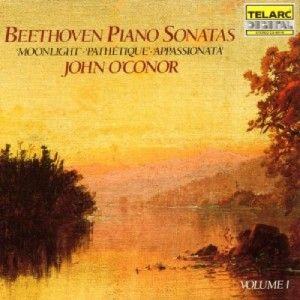
As três sonatas do Op. 2, são obras em estrita sonata-forma, nos quatro movimentos protocolares, com um minueto/scherzo como terceiro movimento, etc. Não é à toa que foram dedicadas a Haydn, o mais famoso compositor da época, e que fora, brevemente, professor de Beethoven. São tão bem-acabadas que até mesmo o pancadinha Glenn Gould, notório sabotador das obras de Lud Van (quem escutou sua “Appassionata” sabe do que estou falando), declarou sua admiração por elas e fez gravações razoavelmente atentas à partitura e reverentes às intenções do compositor. Creio que elas se prestem muito bem ao estilo limpo de O’Conor, que não exagera nos contrastes dinâmicos, nem procura oportunidades de bravado onde elas pouco existem.
Em outras palavras: a turma do Lang Lang vai odiar.
Troquei o servidor para o Google Drive. Creio que agora o pessoal vai poder baixar os arquivos sem maiores problemas.
Ah, os russos… Que podemos dizer deles quando o assunto são os grandes violinistas do passado? David Oistrakh e Leonid Kogan entre outros, eram músicos excepcionais, acima da condição normal de um ser humano, eram seres iluminados, abençoados com um dom único, o de extrair de uma caixinha de madeira com quatro cordas toda a emoção que pudesse ser exposta. Não bastava o que estava no papel, havia de se ler o que estava nas entrelinhas, subentendido.
Leonid Kogan nasceu em 1924 e faleceu em 1983, em uma estação de trem, onde ia embarcar para mais uma apresentação. Foi casado com uma irmã do grande pianista Emil Gilels, que também era violinista, e pai de outro violinista. Leonid Kogan foi um gigante absoluto do instrumento, e neste CD toca cinco peças básicas do repertório do instrumento. Senti falta do Concerto de Mendelssohn, mas tudo bem. Kogan só foi apresentado ao Ocidente em 1958, tocando exatamente o Concerto de Brahms, e fez um sucesso estrondoso.
Kogan não foi tão prolífico em termos de gravação quanto seu amigo mais velho, David Oistrakh. Mas o que gravou foi o suficiente para demonstrar todo o seu imenso talento.
A gravadora EMI contratou para essas gravações dois grandes maestros russos para acompanhar o músico: Kiril Kondrashin e Constantin Silvestri, ou seja, nada pode dar errado quando temos estes nomes envolvidos.
Espero que apreciem, fã que sou da escola russa de violino, sei que os senhores também irão gostar.
CD 1
01. Brahms Violin Concerto in D, Op.77 – I. Allegro non troppo
02. Brahms Violin Concerto in D, Op.77 – II. Adagio
03. Brahms Violin Concerto in D, Op.77 – III. Allegro giocoso, ma non troppo vivace
04. Lalo Symphonie espagnole, Op.21 – I. Allegro non troppo
05. Lalo Symphonie espagnole, Op.21 – II. Scherzando (Allegro molto)
06. Lalo Symphonie espagnole, Op.21 – III. Intermezzo ( Allegro non troppo)
07. Lalo Symphonie espagnole, Op.21 – IV. Andante
08. Lalo Symphonie espagnole, Op.21 – V. Rondo (Allegro)
09. Tchaikovsky Serenade melancholique, Op.26
Leonid Kogan – Violin
Philharmonia Orchestra
Kiril Kondrashin – Conductor
CD 2
01. Beethoven Violin Concerto in D major, op.61 – I. Allegro ma non troppo
02. Beethoven Violin Concerto in D major, op.61 – II. Laghetto
03. Beethoven Violin Concerto in D major, op.61 – III. Rondo Allegro
04. Tchaikovsky Violin Concerto in D major, op.35 – I. Allegro moderato
05. Tchaikovsky Violin Concerto in D major, op.35 – II. Canzonetta Andante
06. Tchaikovsky Violin Concerto in D major, op.35 – III. Finale Allegro vivace
Leonid Kogan – Violin
Orchestre de la Societé des Concerts du Conservatoire
Constantin Silvestri – Conductor
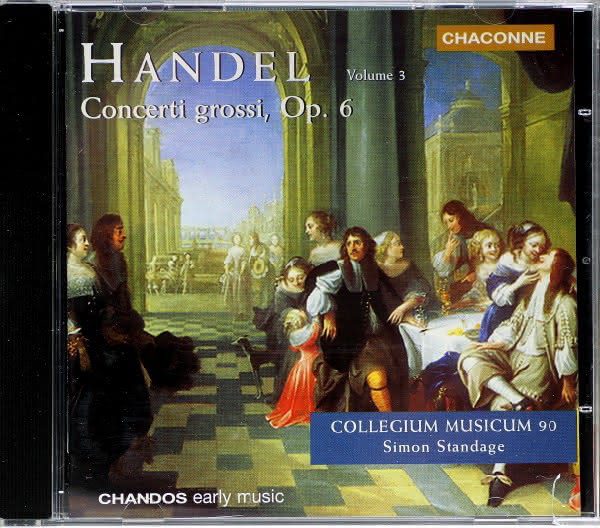
Já postamos estes concertos diversas vezes. Eles são mesmo ótimos e estão presentes nos repertórios dos melhores grupos barrocos, mas não creio que alguém roubaria ou mataria por eles. Os 12 Concerti Grossi, Op. 6, ou Doze Grandes Concertos, HWV 319-330, são concertos escritos por Händel para um trio de concertinos de dois violinos e um violoncelo, orquestra de cordas e cravo contínuo. Foram publicados pela primeira vez em Londres no ano de 1739. Tendo como modelo os antigos concerti da chiesa e concerti da câmera de Arcangelo Corelli, e não os concertos venezianos de três movimentos de Vivaldi, eles foram escritos, pasmem, para serem tocados durante os intervalos das apresentações dos oratórios e odes de Handel. Apesar do modelo convencional, Handel incorporou nos movimentos toda a gama dos seus estilos composicionais, incluindo trio sonatas, árias, aberturas francesas, sinfonias italianas, fugas, temas, variações e uma variedade de danças. Os concertos foram em grande parte compostos de material novo: eles estão entre os melhores exemplos no gênero de concerto grosso barroco.
G. F. Händel (1685-1759): Concerti Grosso, Op. 6, Vol. 3
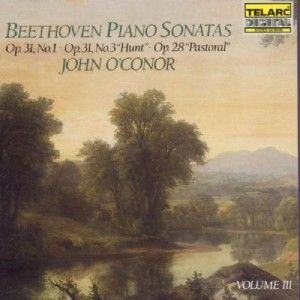
Mais Beethoven, mais O’Conor, mais sonatas com apelidos, e poucos deles me parecem mais incompreensíveis do que “A Caça” para a Op. 31 no. 3, que é notável pelo fato de não ter movimentos lentos. A primeira do Op. 31, que abre este disco, é das minhas preferidas: composta em 1801, em meio a uma guirlanda de obras-primas, mostra com todas as garrinhas o Beethoven ácido e inventivo das décadas seguintes. Da “Pastoral”, em Ré maior, nada se precisa dizer, até porque eu já escrevi “obra-prima” logo acima, e não pretendo ser repetitivo.
LUDWIG VAN BEETHOVEN (1770-1827)
SONATAS PARA PIANO, VOL. III – JOHN O’CONOR
Sonata no. 15 em Ré maior, Op. 28, “Pastoral”
01 – Allegro
02 – Andante
03 – Scherzo: Allegro vivace
04 – Rondo: Allegro ma non troppo
Problemas alheios à nossa vontade me fizeram trocar de servidor de armazenamento de meus arquivos (sim, mais uma vez o MEGA está fora do ar, aparentemente ação de hackers). E mais uma vez, estou trocando de servidor, desta vez estou migrando para o Zippyshare, que, segundo a propaganda, é gratuito e não tem limite de espaço. Aguardo a opinião dos senhores. Não sei se o MEGA vai voltar, e não, se não voltar, lamento, mas não tenho como subir novamente todo o meu acervo armazenado lá, sei lá quanto é.
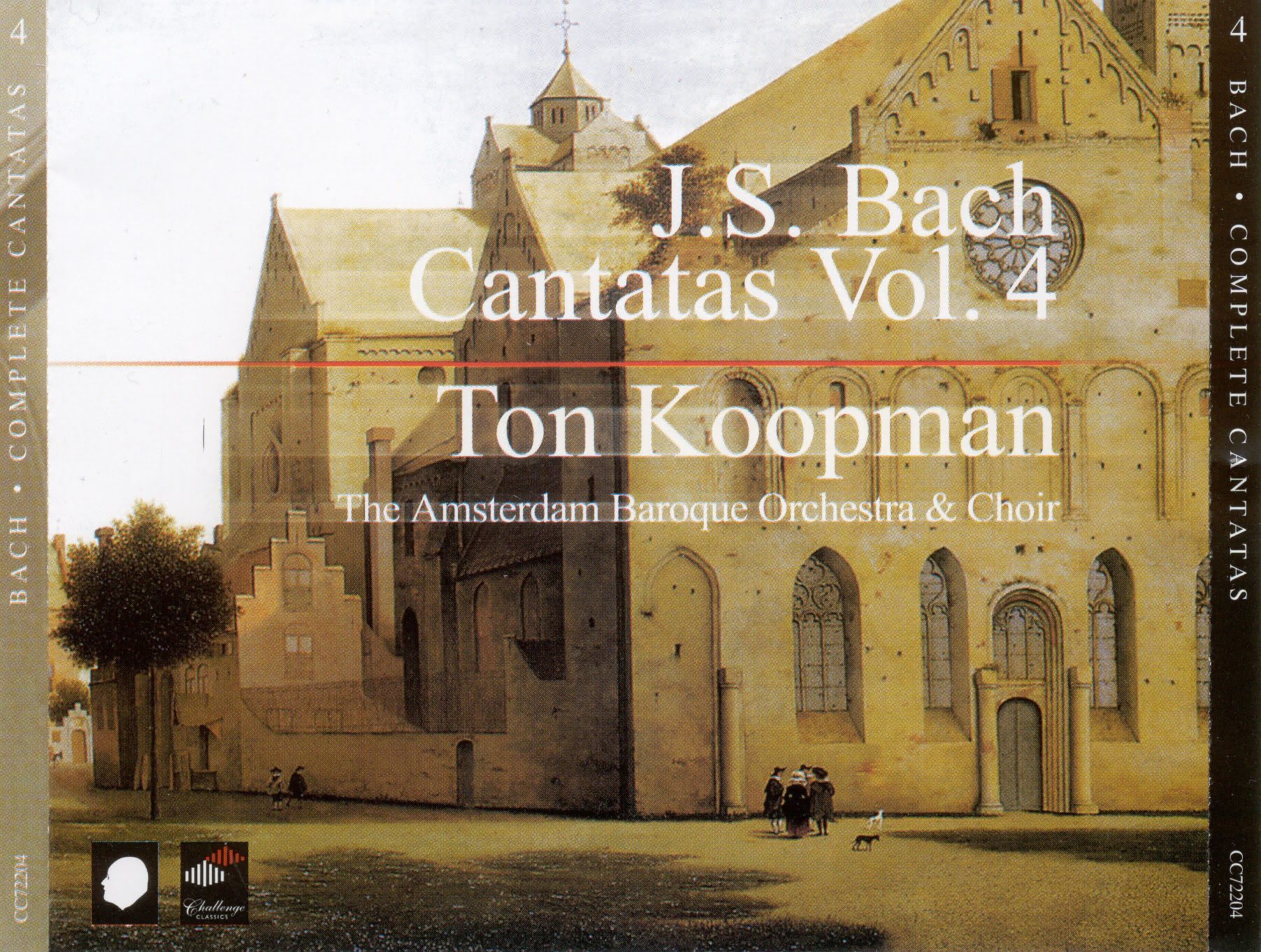
O Quarto Volume da integral das Cantatas de Bach nas mãos de Ton Koopman está, como não poderia deixar de ser, impecável. Aqui teremos as magníficas Cantatas Seculares e foram compostas durante o período em Leipzig. Abaixo, um trecho do booklet explica :
“The fourth volume of the complete recordings of Bach’s cantatas is devoted exclusively to secular cantatas of the Leipzig period essentially from the years 1726-1734. Actually the term “secular cantata” is completely foreign to Johann Sebastian Bach and his time. It first became established in the latter half of the 19th century and paved the way for an almost fatal polarisation in the evaluation of Bach’s secular and religious vocal music, of which the effects are evident to this day, in both research and performance. In fact it is quite artificial to oppose sacred cantatas against secular. The first genre to emerge was the secular cantata, for the Italian term “cantata” was first used in the 17th century to designate the musical setting of a secular text, and it was not until 1700 in Protestant Germany that it was used to describe sacred music, when Erdmann Neumeister published his librettos Geistliche Cantatevi statt einer Kirchen-Musik in Weissenfeis, with far-reaching influence.”
Com exceção do Baixo Klaus Mertens e do tenor Paul Agnew, sempre presentes em outros volumes da coleção, Koopman troca aqui todos os outros cantores. A listagem está abaixo. Espero que apreciem esta postagem, sempre feita a toque de caixa, em virtude da total falta de tempo, e deste contratempo relatado acima, relativo ao servidor.
P.S. 1 – Depois de muitas reclamações, resolvi trocar de servidor de armazenamento. Agora estou usando o Google Drive, com o qual não creio que vá ter maiores problemas.
CD 1
“Laß Fürstin, laß noch einen Strahl” BWV 198
1 Chorus: “Laß Fürstin, laß noch einen Strahl”
2 Recitative (Soprano): “Dein Sachsen, dein bestürztes Meissen”
3 Aria (Soprano): “Verstummt, verstummt, ihr holden Saiten!”
4 Recitative (Alto): “Der Glocken bebendes Getön”
5 Aria (Alto): “Wie starb die Heldin so vergnügt!”
6 Recitative (Tenor): “Ihr Leben ließ die Kunst zu sterben”
7 Chorus: “An dir, du Fürbild grosser Frauen”
8 Aria (Tenor): “Der Ewigkeit saphirnes Haus”
9 Recitative (Bass): “Was Wunder ist’s?”
10 Chorus: “Doch, Königin! du stirbest nicht”
Lisa Larsson soprano
Elisabeth von Magnus alto
Paul Agnew tenor
Klaus Mertens bass
“Preise dein Glücke gesegnetes Sachsen” BWV 215
11 Chorus: “Preise dein Glücke, gesegnetes Sachsen”
12 Recitative (Tenor): “Wie können wir, großmächtigster August”
13 Aria (Tenor): “Freilich trotzt August’ Name”
14 Recitative (Bass): “Was hast dich sonst, Sarmatien, bewogen”
15 Aria (Bass): “Rase nur, verwegner Schwärm”
16 Recitative (Soprano): “Ja, ja! Gott ist uns noch mit seiner Hülfe nah”
17 Aria (Soprano): “Durch die von Eifer entflammeten Waffen”
18 Recitative and arioso (Tenor, Bass, Soprano): “Laß doch, o teurer Landesvater, zu”
19 Chorus: “Stifter der Reiche, Beherrscher der Kronen”
Eis Bongers soprano
Paul Agnew tenor
Klaus Mertens bass
1 Recitative (Tenor): “Schweigt stille, plaudert nicht”
2 Aria (Bass): “Hat man nicht mit seinen Kindern”
3 Recitative (Soprano, Bass): “Du böses Kind, du loses Mädchen”
4 Aria (Soprano): “Ei! wie schmeckt der Coffee süße”
5 Recitative (Soprano, Bass): “Wenn du mir nicht den Coffee läßt”
6 Aria (Bass): “Mädchen, die von harten Sinnen”
7 Recitative (Soprano, Bass): “Nun folge, was dein Vater spricht”
8 Aria (Soprano): “Heute noch, lieber Vater tut es doch”
9 Recitative (Tenor): “Nun geht und sucht der alte Schlendrian”
10 Chorus (Soprano, Tenor, Bass): “Die Katze läßt das Mausen nicht”
Anne Grimm soprano (Liesgen)
Paul Agnew tenor
Klaus Mertens bass (Herr Schlendrian)
“Tönet, ihr Pauken! Erschallet, Trompeten!” BWV 214
11 Chorus: “Tönet, ihr Pauken! Erschallet, Trompeten!”
12 Recitative (Tenor): “Heut ist der Tag, wo jeder sich erfreuen mag”
13 Aria (Soprano): “Blast die wohlgegriffnen Flöten”
14 Recitative (Soprano): “Mein knallendes Metall”
15 Aria (Alto): “Fromme Musen! meine Glieder!”
16 Recitative (Alto): “Unsre Königin im Lande”
17 Aria (Bass): Kron und Preis gekrönter Damen”
18 Recitative (Bass): “So dringe in das weite Erdenrund”
19 Chorus: “Blühet, ihr Linden in Sachsen, wie Zedern!”
Eis Bongers soprano
Elisabeth Von Magnus alto
Paul Agnew tenor
Klaus Mertens bass
“Non sa che sia dolore” BWV 209
20 Sinfonia
21 Recitative: “Non sa che sia dolore”
22 Aria: “Parti pur, e con dolore” 8’31
23 Recitative: “Tuo saver al tempo e l’età contrasta”
24 Aria: “Ricetti gramezza e pavento”
Lisa Larsson, soprano
CD 3
“Ich bin in mir vergnügt” BWV 204
1 Recitative: “Ich bin in mir vergnügt”
2 Aria: “Ruhig und in sich zufrieden”
3 Recitative: “Ihr Seelen, die ihr außer euch”
4 Aria: “Die Schätzbarkeit der weiten Erden”
5 Recitative: “Schwer ist es zwar, viel Eitles zu besitzen”
6 Aria: “Meine Seele sei vergnügt”
7 Recitative and arioso: “Ein edler Mensch ist Perlenmuscheln gleich”
8 Aria: “Himmlische Vergnügsamkeit”
Lisa Larsson, soprano
“Geschwinde, ihr wirbelnden Winde” BWV 201
9 Chorus: “Geschwinde, geschwinde ihr wirbelnden Winde”
10 Recitative (Soprano, Bass I & II): “Und du bist doch so unverschämt und frei”
11 Aria (Soprano): “Patron, das macht der Wind”
12 Recitative (Alto, Bass I & II): “Was braucht ihr euch zu zanken?”
13 Aria (Bass 1): “Mit Verlangen”
14 Recitative (Soprano, Bass II): “Pan, rükke deine Kehle nun”
15 Aria (Bass II): “Zu Tanze, zu Sprunge, so wakkelt das Herz”
17 Aria (Tenor): “Phoebus, deine Melodei”
18 Recitative (Bass II, Tenor II): “Komm, Midas, sage du nun an”
19 Aria (Tenor): “Pan ist Meister, laßt ihn gehn!”
20 Recitative (Soprano, Alto, Tenor I & II, Bass I & II): “Wie, Midas, bist du toll?”
21 Aria (Alto): “Aufgeblasne Hitze, aber wenig Grütze”
22 Recitative (Soprano): “Du guter Midas, geh nun hin”
23 Chorus: “Lobt das Herz, ihr holden Saiten”
Caroline Stani soprano (Momus)
Peter de Groot alto (Mercurius)
Paul Agnew tenori (Tmolus)
Jeremy Ovenden tenor II (Midas)
Klaus Mertens bass I (Phoebus)
Donald Bentvelsen bass II (Pan)
THE AMSTERDAM BAROQUE ORCHESTRA & CHOIR
TON KOOPMAN
Um grande disco, magnificamente interpretado! O Concerto de Bach para Oboé é maravilhoso, mas logo depois temos a Cantata do Casamento, BWV 202. Esta Cantata é linda. A primeira ária me mói o coração. Tudo, a lentidão inicial, os passos, a seção rápida, o retorno. Que ária! E que lindo trabalho fazem todos aqui.
Esta primeira ária, “Weichet nur, betrübte Schatten” (Dissipai, sombras problemáticas), é acompanhada por todos os instrumentos. As cordas reproduzem um motivo repetitivo ilustrando o desaparecimento do inverno, enquanto o oboé conduz com uma linda melodia até a entrada da voz, depois tocando em dueto com ela. A seção de abertura é marcada como Adagio, enquanto a seção intermediária, sobre os prazeres da primavera, é marcada como Andante. É a mudança da sombra para a luz do sol, do frio do inverno para as flores da primavera.
A BWV 202 sobreviveu através de apenas uma cópia da década de 1730. Ela apresenta um estilo usado por Bach apenas até por volta de 1714. O lento-rápido-lento da primeira ária, por exemplo, foi raramente utilizado por Bach depois de 1714. Também o jogo entre a voz e o oboé obbligato do sétimo movimento é da mesma época. Mas os biógrafos pensam que esta Cantata é do tempo de Köthen e a ocasião a um casamento, possivelmente o próprio casamento de Bach com Anna Magdalena em dezembro de 1721. O libretista não é conhecido.
O texto relaciona o início do amor à chegada da primavera após o inverno. O cupido procura por um casal. Ele os encontra. Há o desejo de sorte. O tom é bem humorado e brincalhão, o que sugere um casamento civil.
O restante do CD também é de primeira linha.
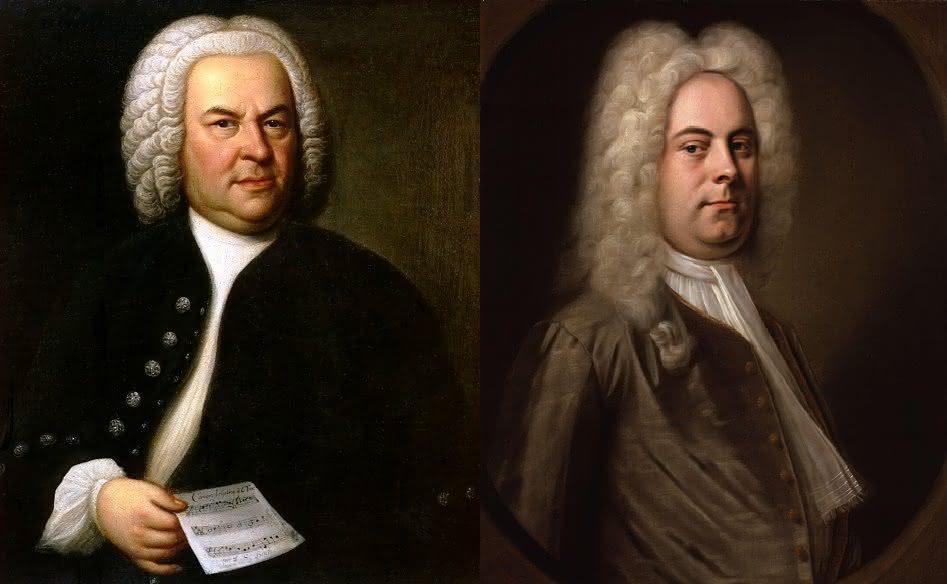
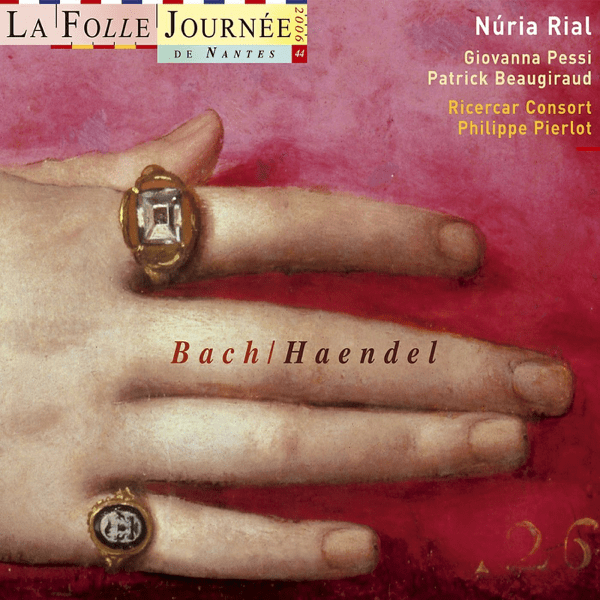
J. S. Bach (1685-1750): Concerto para Oboé / Cantata BWV 202 & G. F. Händel (1685-1759): Concerto Nº 1 para Harpa / Cantata Tra Le Fiamme, HWV 170
1 Concerto en la Majeur, BWV 1005A: I. Allegro 4:26
2 Concerto en la Majeur, BWV 1005A: II. Larghetto 5:10
3 Concerto en la Majeur, BWV 1005A: III. Allegro Ma Non Troppo 4:28
Patrick Beaugiraud
Ricercar Consort
Philippe Pierlot
4 “Weichet Nur, Betrübte Schatten”, BWV 202: Aria – Weichet Nur, Betrübte Schatten 6:18
5 “Weichet Nur, Betrübte Schatten”, BWV 202: Récitatif – Die Welt Wird Wieder Neu 0:27
6 “Weichet Nur, Betrübte Schatten”, BWV 202: Aria – Phoebus Eilt 2:55
7 “Weichet Nur, Betrübte Schatten”, BWV 202: Aria – Drum Sucht Auch Amor 0:41
8 “Weichet Nur, Betrübte Schatten”, BWV 202: Récitatif – Wenn Die Frühlingslüfte Streichen 2:29
9 “Weichet Nur, Betrübte Schatten”, BWV 202: Récitatif – Und Dieses Ist Das Glücke 0:49
10 “Weichet Nur, Betrübte Schatten”, BWV 202: Aria – Sich Üben Im Lieben 4:17
11 “Weichet Nur, Betrübte Schatten”, BWV 202: So Sei Das Brand Der Keuschen Liebe 0:22
12 “Weichet Nur, Betrübte Schatten”, BWV 202: Gavotte – Sehet In Zufriedenheit 1:35
Nuria Rial
Patrick Beaugiraud
Philippe Pierlot
Ricercar Consort
13 Concerto Pour Harpe No. 1 en Si Majeur, Op. 4 No. 6: I. Andante Allegro 6:00
14 Concerto Pour Harpe No. 1 en Si Majeur, Op. 4 No. 6: II. Larghetto 3:48
15 Concerto Pour Harpe No. 1 en Si Majeur, Op. 4 No. 6: III. Allegro Moderato 2:34
Giovanna Pessi
Ricercar Consort
Philippe Pierlot
16 Tra Le Fiamme, HWV 170: Aria – Tra Le Fiamme Tu Scherzi Per Gioco 5:28
17 Tra Le Fiamme, HWV 170: Recitativo – Dedalo Già Le Fortunate Penne 0:49
18 Tra Le Fiamme, HWV 170: Aria – Pien Di Nuovo e Bel Diletto 4:39
19 Tra Le Fiamme, HWV 170: Recitativo – Si, Pur Troppo e Vero 0:14
20 Tra Le Fiamme, HWV 170: Aria – Voli Per L’aria Chi Puo Volare 2:56
21 Tra Le Fiamme, HWV 170: Recitativo – L’uomo Che Macque Per Salire Al Cielo 0:21
22 Tra Le Fiamme, HWV 170: Aria – Tra Le Fiamme Tu Scherzi Per Gioco 2:30
Nuria Rial
Philippe Pierlot
Ricercar Consort
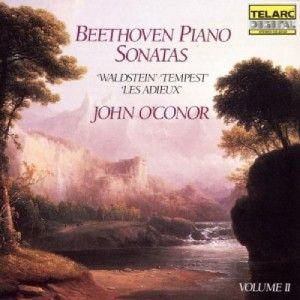
Prosseguindo a série da integral das Sonatas para piano de Lud Van com John O’Conor, alcanço-lhes o segundo tomo.
Se aqui o critério da gravadora parece ter sido outra vez selecionar sonatas com apelidos célebres, este recital resulta mais equilibrado, por conta das obras melhor buriladas. Se o movimento inicial da “Waldstein” pode soar como o desfraldar de cortinas, o “Wiedersehen” de “Les Adieux” fecha-as deixando tudo redondinho.
LUDWIG VAN BEETHOVEN (1770-1827)
SONATAS PARA PIANO, VOL. II – JOHN O’CONOR
Sonata no. 21 em Dó maior, Op. 53, “Waldstein”
01 – Allegro con brio
02 – Introduzione: Adagio molto
03 – Rondo: Allegretto moderato
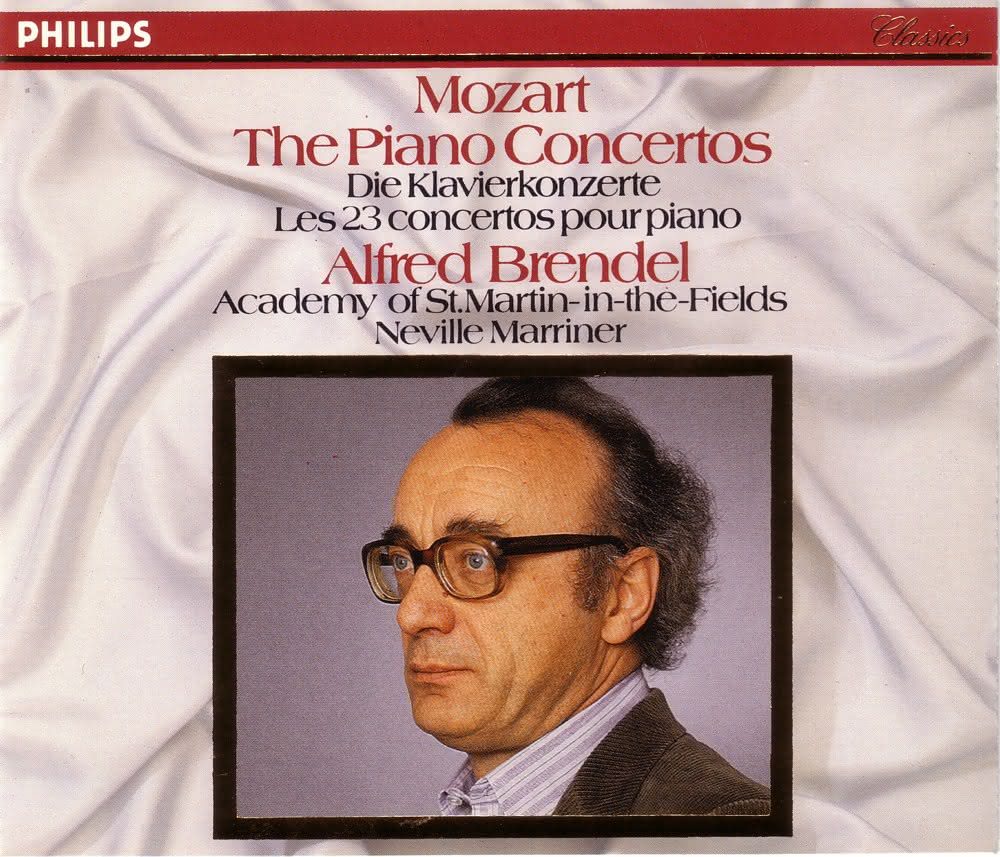
É impressionante pensar que em um ano, Mozart compôs seis concertos e, mais ainda, se pensarmos que não havia uma receita de bolo a seguir: foram concertos inovadores em comparação com os anteriores. Como estamos indo de trás pra frente, hoje o dia é do 15º ao 18º, todos compostos em 1784.
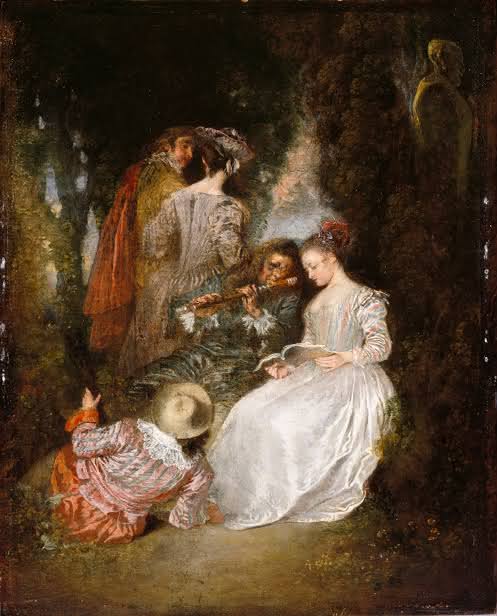
O Concerto nº 15 já começa quebrando paradigmas, com o oboé e o fagote tocando sozinhos, para só no terceiro compasso os violinos e violas entrarem. As partes das madeiras nos concertos de Mozart, a partir deste 15º, ganham independência em relação às cordas. É um concerto com uma atmosfera bucólica, pastoral, um pouco como um dos quadros de Watteau (1684-1721), pintor francês que representa como poucos o Antigo Regime naquelas cenas campestres onde os aristocratas se divertiam sem se preocupar com o dia de amanhã. As paisagens campestres bucólicas de Watteau são palco de festas e encontros, formando retratos vivos de uma época considerada decadente mas extremamente elegante e requintada.
A flauta em “Accord Parfait” de Watteau
O Concerto 17 é outro que também combina com essa elegância bucólica do mundo pré-Revolução. Flauta, oboé e fagote fazem uma entrada surpresa no 4º compasso, algo que seria impensável nos concertos de juventude de Mozart. Como escreveu Aaron Copland, o oboé tem um som algo pastoral, enquanto o fagote, nos seus registros mais graves, é capaz de um staccato bem-humorado, que tem um efeito quase cômico.
Wolfgang Amadeus Mozart (1756 – 1791)
Concerto para piano e orquestra n. 15 em Si Bemol Maior, KV. 450
1. Allegro
2. Andante
3. Allegro
Concerto para piano e orquestra n. 16 em Ré Maior, KV. 451
1. Allegro
2. Andante
3. Allegro di Molto
Concerto para piano e orquestra n. 17 em Sol Maior, KV. 453
1. Allegro
2. Andante
3. Allegretto – Finale (presto)
Concerto para piano e orquestra n. 18 em Si Bemol maior, KV. 456
1. Allegro Vivace
2. Andante un poco sustenuto
3. Allegro Vivace
Academy of St. Martin in the Fields
Alfred Brendel, Piano
Sir Neville Marriner, regência
Imaginem só a cena: 1790, coroação de Leopoldo II como imperador do Sacro-Império Germânico, toda a pompa e circunstância na frente de incontáveis príncipes, duques e similares daquelas dezenas de reinos que formariam a Alemanha, todos querendo se impor para evitar o destino de Luís XVI, que ainda não tinha perdido a cabeça mas estava quase lá. Agora imaginem se a orquestra começasse a tocar a introdução densa, sombria e misteriosa do Concerto nº 20. Seria desastre garantido. Se introduzisse o sério tema do Concerto nº 21, apesar da indicação allegro maestoso, também não sei se os duques e os cardeais iriam aprovar.
O Concerto nº 19, que o acadêmico inglês A. Hutchings descreve como “atlético, combinando graça e vigor”, também é considerado o “outro” concerto da coroação, pois foi tocado por Wolfgang, junto com o nº 26, na coroação de Leopoldo II como imperador do Sacro-Império Germânico em 1790. O 20 e o 21, que o acompanham aqui, são bem diferentes e dificilmente seriam convenientes para aquela ocasião majestosa enquanto a Revolução Francesa espreitava. O Concerto nº 19 foi escrito em dezembro de 1784 e os dois seguintes, em fevereiro e março de 1785 (!).Essa sequência impressionante de concertos acompanha o período provavelmente de maior sucesso de Mozart com o público vienense.
Após as muitas viagens que Mozart fez quando criança, é quase certo que uma das razões para sua permanência em Viena a partir de 1781 foi a grande liberdade de opinião que vigorava naquela cidade. Segundo o padre que foi seu professor de direito, José II era um estudante “interessado pelas ideias novas, pelos ‘direitos humanos’ e pelo bem-estar do povo”.
Muito diferente era a situação em outros reinos: na França, por exemplo, quase todas as obras de Voltaire (1694-1778) eram proibidas, sendo publicadas na Holanda ou na Suíça e depois entrando clandestinamente em território francês.
A muitas e muitas léguas, no Brasil, a impressão de qualquer obra era quase impossível, por causa da necessidade das licenças da Inquisição e do Conselho Ultramarino em Portugal. É bom lembrar que só em 1821 se dá a extinção formal da inquisição em Portugal e no Brasil.
Após a Revolução Francesa, a liberdade geral que se vivia em Viena foi pro brejo. Nesses períodos de inquietude, os artistas são os primeiros a terem suas asinhas cortadas. Haydn, por exemplo, teve de ir pra Londres para continuar compondo suas obras orquestrais, mas lá também teve um contratempo: sua ópera L’anima del filosofo, ossia Orfeo ed Euridice (A Alma do Filósofo, ou Orfeu e Eurídice) não teve a licença do rei e só foi estreada muitos anos depois, quanto Haydn já tinha morrido.
Mas voltemos a Mozart. Nessa época, então, ele vivia o auge do seu sucesso de público e crítica: amigo de Haydn, que o respeitava enormemente, brilhando nos palcos de Viena, o que mais ele poderia querer? Talvez inventar um novo tipo de concerto para piano, após os seus dezenove anteriores, todos em tons maiores?
Isso ele fez com o Concerto nº 20, em ré menor. Na mesma tonalidade da famosa ária da Rainha da Noite, o concerto já começa com um clima misterioso e noturno que dura até o final. A popularidade deste concerto pode ser julgada pela lista de compositores que escreveram cadências para ele, provavelmente ao interpretá-lo eles mesmos ao piano:
Ludwig van Beethoven (1770-1827), que chegou a Viena Em 1792, já com 21 anos de idade, mudou-se definitivamente para Viena em 1792 (apenas um ano após a morte, na cidade, de Mozart),
Johann Nepomuk Hummel (1778-1837), que também era criança-prodígio, foi aluno de Mozart por dois anos e publicou um dos principais tratados sobre o pianoforte em 1828,
Franz Xaver Mozart (1791-1844), filho de Wolfgang,
Clara Schumann (1819-1896) e Johannes Brahms (1833-1897), que dispensam apresentações.
Será que os célebres concertos românticos em tons menores, como o de Schumann, os dois de Chopin e o de Grieg, existiriam sem o ré menor de Mozart?
O Concerto nº 21, em dó maior, é menos inovador mas também muito popular, especialmente o movimento lento.
Wolfgang Amadeus Mozart (1756 – 1791)
Concerto para piano e orquestra n. 19 em Fá maior, KV. 459
1. Allegro vivace
2. Allegretto
3. Allegro assai
Concerto para piano e orquestra n. 20 em Ré Menor, KV. 466
1. Allegro
2. Romance
3. Rondo (Allegro Assai)
Concerto para piano e orquestra n. 21 em Dó maior, KV. 467
1. Allegro maestoso
2. Andante
3. Allegro vivace assai
Academy of St. Martin in the Fields
Alfred Brendel, Piano
Sir Neville Marriner, regência
Enquanto vocês estão a me ler, eu estou a caminho do Congo, onde deverei passar uma boa parte das próximas semanas.
Sim, falo sério.
E o que vocês têm com isso?
Nada, é claro: afinal de contas, vocês só querem postagens novas, e estão pouco se lixando onde Vassily está quando sua postagem nova aparece para vocês enquanto se preparam para o almoço, não é?
Bem que fazem, leitores!
Só menciono a expedição ao Congo para justificar, de antemão, por que minhas postagens serão mais sucintas, e talvez repetitivas, ao longo deste setembro. Por ora, posso-lhes dizer que aqueles que detestam piano devem iniciar os preparativos para a urticária. Mas vocês não seriam desalmados a ponto de xingarem alguém que está no Congo, certo?
Esta integral com as Sonatas de Beethoven por John O’Conor, feita por um especialista na obra pianística do velho Ludovico, é uma gravação aclamada pela crítica. Eu a vi ser tão incensada que temi uma decepção cabal ao escutá-la, o que felizmente não aconteceu. Era a minha preferida até escutar a série com Pollini, e continua entre minhas mais queridas, junto com as de Schnabel, Gulda e Brendel (sim, vocês podem ter outras – mas estas são as minhas).
O’Conor reúne, talvez, o que as gravações do notável trio de austríacos têm de melhor, acrescentando um quê de, sei lá como chamá-la, talvez “sanguinidade”, que torna suas interpretações muito atraentes. Neste primeiro volume da série, claro, a gravadora fez questão de colocar as Sonatas mais célebres, aquelas com apelidos apelativos, para ver se seduz o ouvinte familiarizado com elas a comprar os oito volumes restantes. Ainda assim, e em que pese o som um pouco opaco da Teldec, a “Patética”, a “Luar” e a “Appassionata” são defendidas com brilho por O’Conor, cujas interpretações, aparentemente despojadas à primeira audição, só revelam riqueza e complexidade ao longo de revisitas.
LUDWIG VAN BEETHOVEN (1770-1827)
SONATAS PARA PIANO, VOL. I – JOHN O’CONOR
Sonata no. 8 em Dó menor, Op. 13, “Patética”
01 – Grave – Allegro di molto e con brio
02 – Adagio cantabile
03 – Rondo. Allegro
Sonata no. 14 em Dó sustenido menor, Op. 27 no. 2, “Luar”
04 – Adagio sostenuto
05 – Allegretto
06 – Presto
Sonata no. 23 em Fá menor, Op. 57, “Appassionata”
07 – Allegro assai
08 – Andante con moto
09 – Allegro ma non troppo
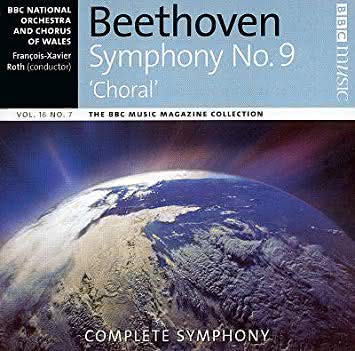
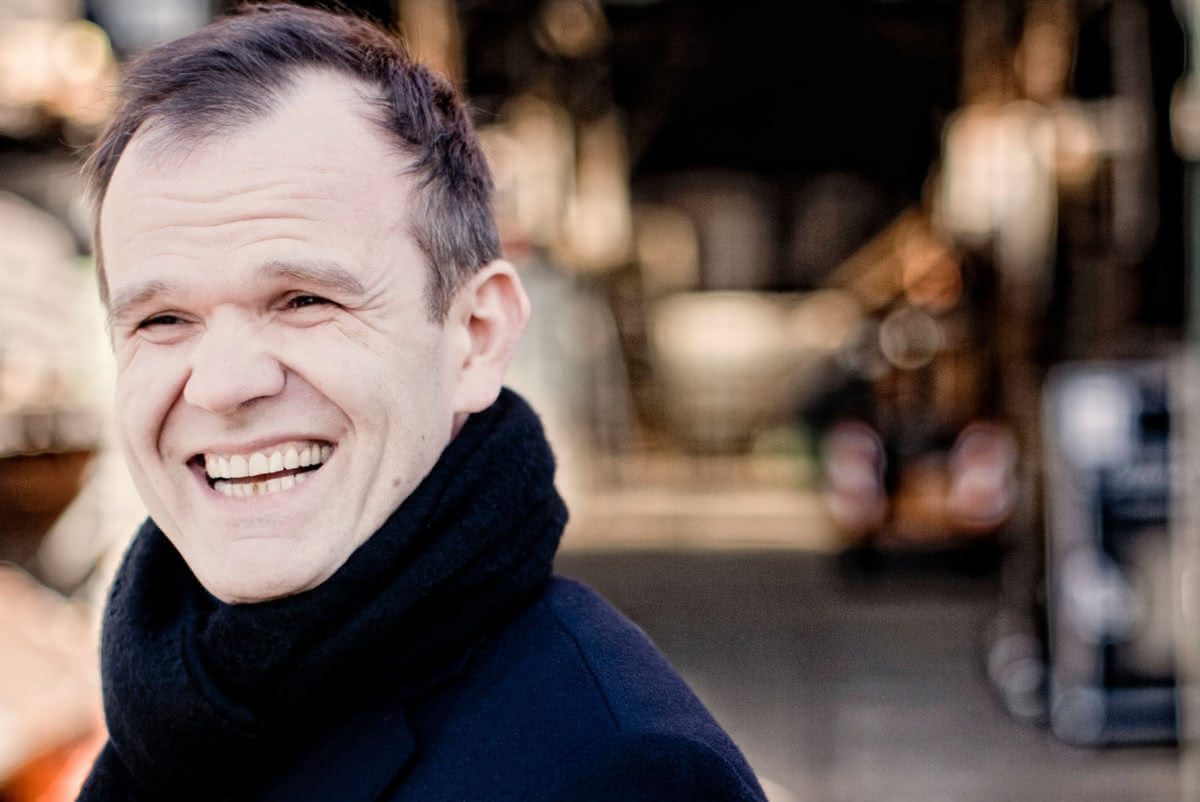
François-Xavier Roth chamou minha atenção por gravar duas obras primas de Stravinsky – A Sagração da Primavera e Petruchka – com a orquestra que ele fundou em 2003, Les Siècles, usando instrumentos de época. Bem, instrumentos de época em que estas peças foram compostas. A Sagração foi estreada em 29 de maio de 1913 e Petruchka em 13 de junho de 1911. A orquestra Les Siècles é inovadora, como seu regente fundador, e usa tanto instrumentos de época como instrumentos modernos, geralmente no mesmo concerto.
Professor Xavier
François-Xavier também rege outras orquestras. Atualmente é o Gürzenich-Kapellmeister und Generalmusikdirektor der Stadt Köln, Diretor Geral de Música da cidade de Colônia. Este posto foi ocupado por Günter Wand! Além disso, é o Principal Regente Convidado da London Symphony Orchestra. É maestro convidado por muitas outras orquestras, em várias partes do mundo.
Assim, quando cruzei com este disco, saltei-lhe em cima. Reunidos aqui temos então um inovador maestro, uma obra das mais icônicas de todo repertório clássico e uma gravação ao vivo, tomada em um festival – plateia entusiasmada!
Há realmente uma sensação de ocasião em toda a interpretação, que tem algumas características das bandas do movimento HIP com as quais já ficamos bastante acostumados. Som mais transparente, com os grupos de instrumentos bem diferenciados, tímpanos bem audíveis e a música fluindo com mais tensão e urgência. A bem da verdade, devo dizer que este é o mais urgente adagio que já ouvi. Batendo em menos do que 12 minutos é mais urgente do que a gravação do Gardiner com a Orchestre Révolutionnaire et Romantique, minha referência para as gravações historicamente informadas. Portanto, se a sua praia é o Beethoven granítico do Klemperer ou Böhm (especialmente a última gravação), pode se agarrar na poltrona, segurar o chapéu e se preparar para torcer o nariz.
Mas, ao final de umas doze audições, assim como eu, começará a achar que era exatamente isso o que o Ludovico queria dizer:
Seid umschlungen, Millionen!
Diesen Kuß der ganzen Welt!
A gravação feita ao vivo em 2007, no Swansea Festival, é muito boa e a plateia só aparece no fim, para aplaudir com muito entusiasmo!
O outro Professor Xavier também gostou da Nona!
Gostei muito de ouvir a Nona mais uma vez com a sensação de descobrimento. Há tempos não fazia isso! Baixe, ouça (é menos do que uma hora…), depois me conte!
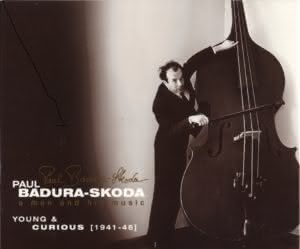
Há dois dias, algumas postagens em minhas redes sociais deram conta do desaparecimento, aos 91 anos, do grande Paul Badura-Skoda, o subdecano dos pianistas (pois o decano é, sem dúvidas, o incansável Menahem Pressler: noventa e seis anos, oito décadas de carreira, participações em todas as formações do Beaux Arts Trio – de Daniel Guilet a Antonio Meneses – estreia com a Filarmônica de Berlim com noventa primaveras, e que tinha um recital marcado com o jovem Badura-Skoda para o mês passado, e que foi cancelado por indisposição do garoto austríaco). Imediatamente, comecei a escrever uma postagem lamentando o fato e celebrando a longa vida artística e, particularmente, o prolífico legado de Paul, fartamente registrado em gravações ao longo de sete décadas, muitas delas, como notou nosso colega Pleyel, em instrumentos de época, antes que esta prática entrasse em voga.
O sono me chamou, e a postagem jazeu incompleta, o que me poupou-me do vigoroso constrangimento de publicá-la só para depois constatar, com alegre cara de tacho, que, assim como acontecera com Mark Twain e das muitas teorias a darem conta de que Sir James Paul is no more, os rumores da morte do Paul austríaco foram grandemente exagerados.
Ainda bem.
Com votos de que o notável vienense se recupere prontamente, deixo-lhes o primeiro duma série de discos comemorando seu septuagésimo quinto aniversário – efeméride que, como veem, já fez seu baile de debutantes. Nele, Paul – adolescente e adulto jovem – deixa-nos alguns bombons, tanto em leituras do repertório tradicional para o piano, em peças a que voltaria dezenas de vezes, quanto em gravações para o acordeão, o instrumento favorito na família Skoda – uma delas, o arranjo para a abertura de La Gazza Ladra, que dedica à mãe pelo seu dia.
Gute Besserung, und komm schnell wieder auf die Beine!
PAUL BADURA SKODA – A MUSICAL BIOGRAPHY – 75h BIRTHDAY TRIBUTE – CD1
Johann Sebastian BACH (1685-1750)
O Cravo bem Temperado, livro 1: Prelúdio e Fuga em Dó sustenido menor, BWV 849
01 – Prelúdio
02 – Fuga
Ludwig van BEETHOVEN (1770-1827)
Sonata para piano no. 21 em Dó maior, Op. 53, “Waldstein”
03 – I. Allegro con brio
Fryderyk Franciszek CHOPIN (1810-1849)
04 – Barcarola em Fá sustenido maior, Op. 60
05 – Fantasia em Fá menor, Op. 49
Hans Ulrich STAEPS (1909-1988)
06 – Pan Pan
Louis GRUENBERG (1884-1964)
07-12 Six Jazz Epigrams
Billy GOLWYN (?-?)
13 – Verbena
Leopold MITTMANN (1904-1976)
14-16 Jazz Babies
Gioachino Antonio ROSSINI (1792-1868)
17 – La gazza ladra: Abertura
Pietro FROSINI (1885-1951)
18 – Serenade italienne
Hermann SCHITTENHELM (1893-1979)
19 – Der Eislaufer (The Ice Skater)
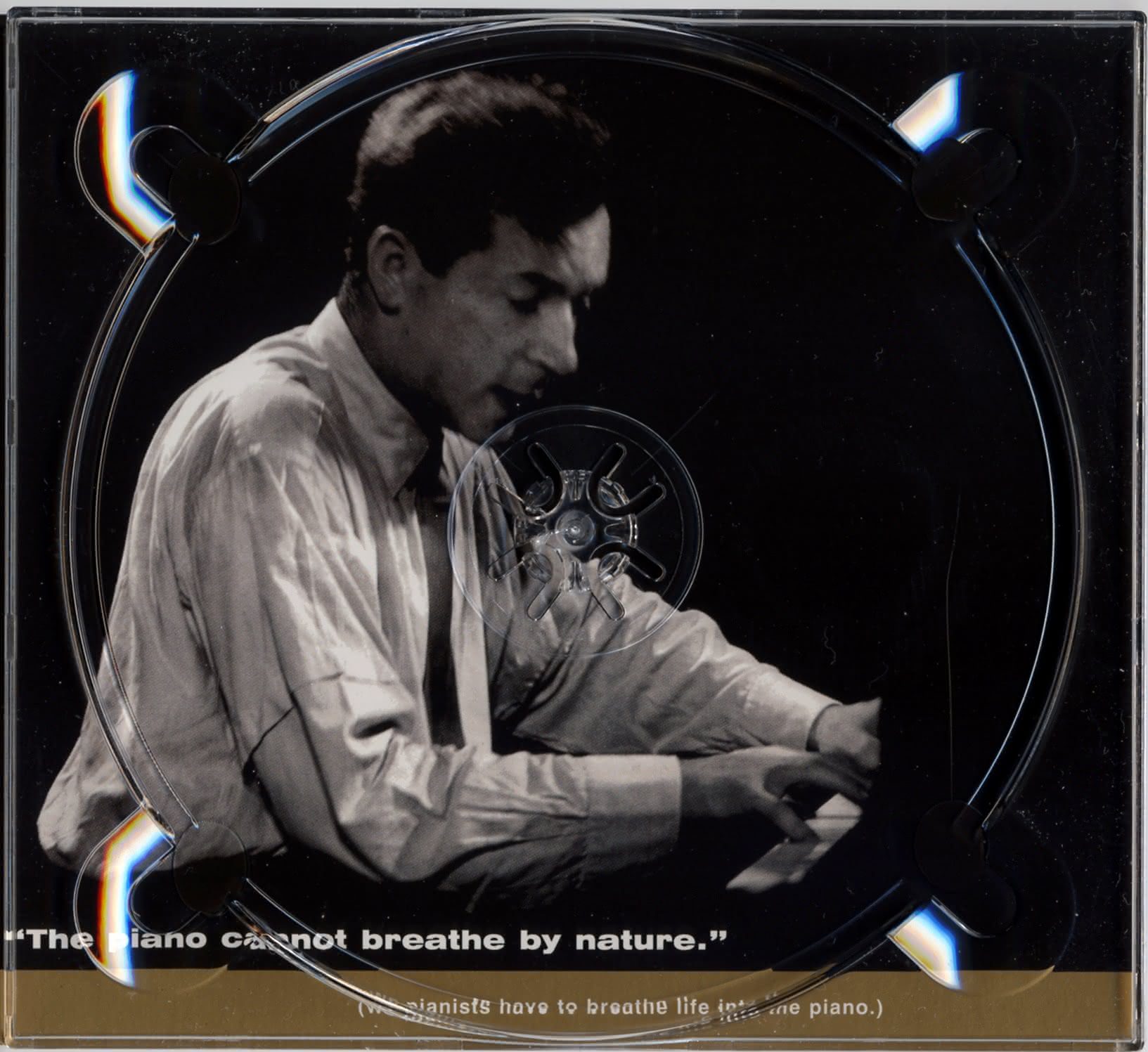
“O piano não consegue respirar naturalmente – o pianista tem que insuflar vida no piano” – por isso que Paul também toca, como faz nesta gravação, o acordeão.
As paisagens como as do Sonho de uma noite de verão ou a Caverna de Fingal são, de certa forma, exteriores ao artista; elas não são ele mesmo. É nos Romances sem Palavras e nas Sinfonias que se deve procurar o Mendelssohn íntimo, o som, a tonalidade e o charme dessa alma. (Camille Bellaigue, 1909)
Década de 1820: Goethe tinha 75 anos quando Mendelssohn, então com doze anos, foi visitá-lo, apresentado por seu professor. Desde este primeiro encontro, Mendelssohn encantou Goethe tocando fugas de Bach e outras obras-primas, de forma que dois anos mais tarde, quando o jovem prodígio voltou a Weimar, o velho poeta, antes de cumprimentá-lo, abriu seu piano e disse “Vem aqui e me faz reviver os os espíritos adormecidos neste piano!” (Fonte: Goethe et Beethoven, por Henri Blaze de Bury, 1813-1888)
1830: Mendelssohn visita Goethe pela última vez e o poeta lhe dá de presente uma página do manuscrito do Fausto com as palavras “Ao amável Felix Mendelssohn, mestre soberano do piano, lembrança de amizade”. Após deixar Weimar e passar por Praga e Munique, em outubro de 1830 Mendelssohn chega a Veneza, aquela cidade única que foi o sonho de sua vida, como ele escreveu a suas irmãs.
Em Roma, onde chega em novembro de 1830, ele faz amizade com o abade Fortunato Santini, dono de uma rica biblioteca musical. Mendelssohn escreve à sua família pedindo que enviem da Alemanha uma coletânea de seis cantatas de Bach para presentear o abade. Em 1831, ainda em Roma, ele conhece o francês Hector Berlioz e as palavras a seguir, das memórias de Berlioz, mostram a relação de admiração um tanto agressiva entre os dois. Berlioz relata:
Um dia, eu falava do metrônomo e de sua utilidade.
“Por que usar o metrônomo?, questionou energicamente Mendelssohn, é um instrumento bastante inútil. Um músico que, olhando uma partitura, não adivinha logo o andamento é uma toupeira.”
No dia seguinte, quando pediu para olhar minha abertura Rei Lear que eu tinha escrito em Nice, ele a leu com atenção e, no momento de colocar os dedos no piano para tocá-la (o que ele fez com um talento incomparável), disse:
“Me dê o seu andamento”,
“Por quê? Você não disse ontem que qualquer um que olha uma partitura e não adivinha o andamento é uma toupeira?” (Fonte: Memórias de Hector Berlioz)
Sua forte ligação com a música de Bach, sua rejeição ao metrônomo, suas sinfonias em quatro movimentos (comparem com a inovadora Sinfonia Fantástica de Berlioz e os Poemas Sinfônicos de Liszt) fazem com que Mendelssohn seja considerado o mais clássico dos românticos. As Canções sem palavras mostram que a cabeça do compositor era mais complexa do que essas classificações. São obras curtas, de harmonia mais simples do que as que Chopin criava na mesma época. Não são equivalentes a noturnos por não terem uma seção contrastante no meio, nem muito menos se assemelham à forma sonata. Para um crítico de 1879, estes pequenos poemas formam, na música para piano, o equivalente dos Lieder de Schubert para o canto. São pequenas joias típicas do século XIX, perfeitas para serem tocadas em salas burguesas por donzelas puras ou senhoras respeitáveis, desde as amadoras até as grandes intérpretes, como Clara Schumann, a quem um dos livros de canções sem palavras foi dedicado.
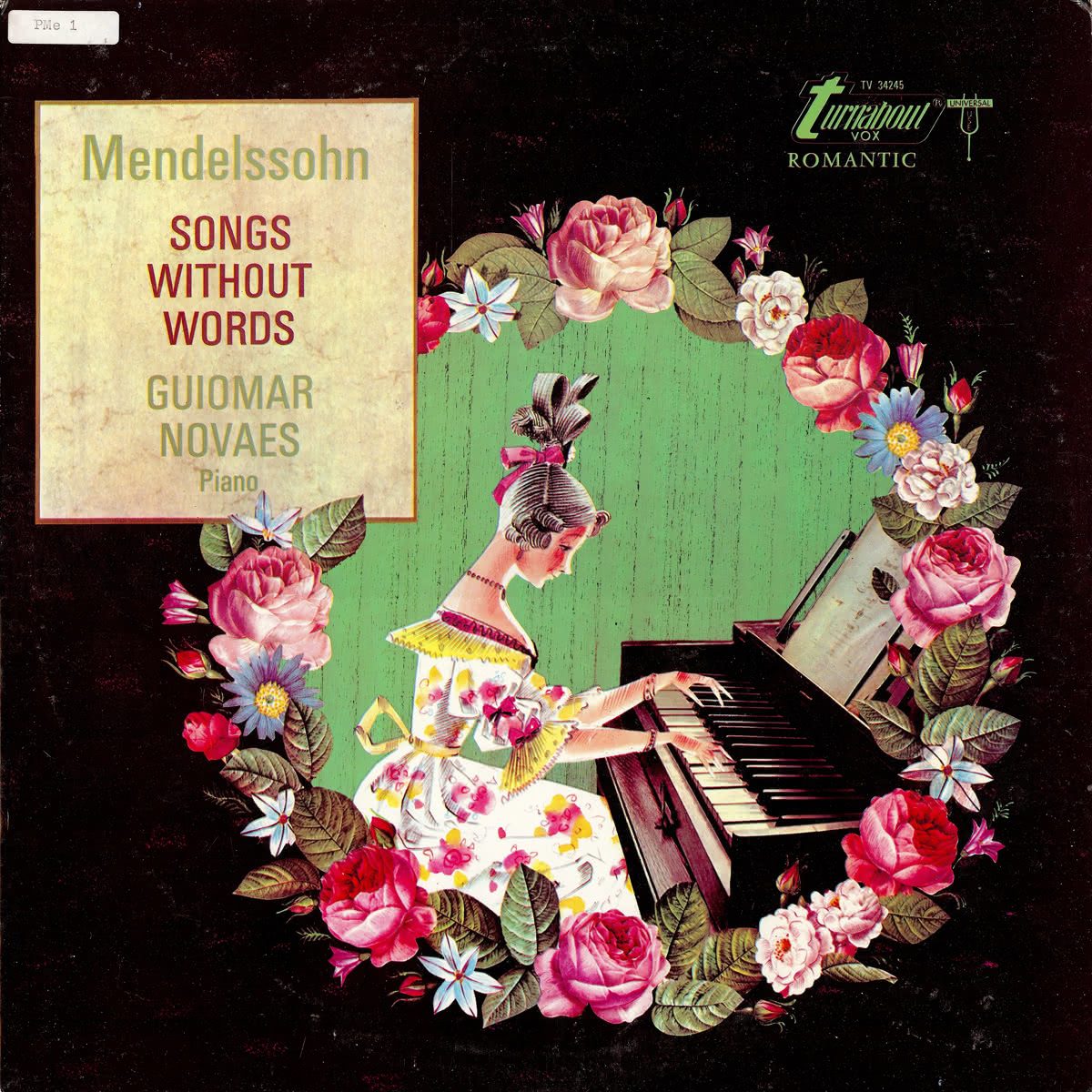
Mendelssohn compôs um total de 48 peças para piano com este nome e mais uma para violoncelo. São pouco adaptadas aos recitais em grandes salas, aos concursos de piano e também, na minha opinião, às gravações de integrais: ouvir as 48 de uma só vez pode ser uma experiência repetitiva. Muito mais prazerosos são os discos em que pianistas tocam uma seleção de canções sem palavras, como um precioso LP gravado por Gieseking e este vinil de Guiomar, jamais editado em CD, que trago hoje para vocês.
Felix Mendelssohn Bartholdy (1809-1847): Songs Without Words (Lieder ohne Worte)
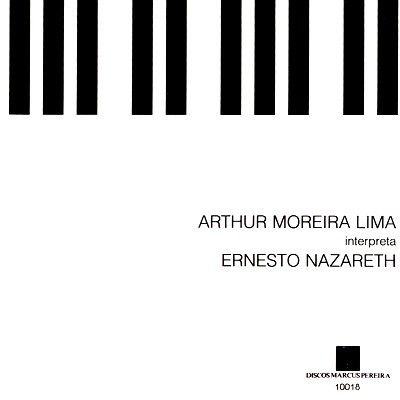
Completamos a coleção com os dois CDs que restavam da série (originalmente em quatro álbuns duplos) de Arthur Moreira Lima interpretando Ernesto Nazareth.
É curioso lembrar que Arthur não só já foi pop o bastante para ter seu programa na TV aberta (“Um Toque de Classe”, na extinta TV Manchete), mas que MÚSICA INSTRUMENTAL já tenha sido um tema suficientemente pulsante entre os brasileiros para ser abordado, entre novelas e comerciais de cigarros, no dito horário nobre:
Arthur sempre foi um top of mind entre os pianistas brasileiros, e assim continua mesmo entre pessoas que nunca viram um piano de perto. Isso talvez explique o imenso sucesso, entre outros, do seu “Piano na Estrada” e da coleção de discos que ele vendeu junto à revista “Caras” nos anos 90. Seu jeito bonachão de sempre, muito atencioso com os fãs, e sua postura cheia de bravado no palco, brandindo a cabeleira e fazendo gestos dramáticos, sintetizam talvez o que o público iniciante espera de um pianista e de um popstar – mais que, provavelmente, todas as notinhas no lugar.
Compreendo que estas sejam circunstâncias extramusicais e que muitos lhe torçam o nariz por isso. Como disse na postagem anterior, esta me parece uma opção deliberada do artista e que, mais ainda, ele é feliz assim. O que é realmente lamentável é as pessoas se esquecerem das gravações de Arthur no zênite de suas forças, como no belíssimo Noturno de Chopin a seguir, que ele tocou em Varsóvia como convidado do Concurso Chopin:
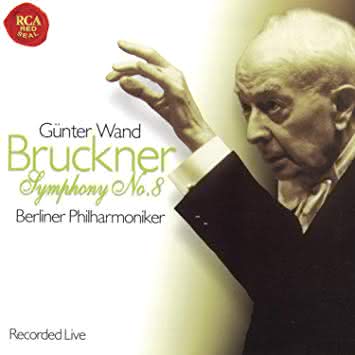
Chegamos ao último post da série com a Sinfonia de Todas as Sinfonias, a Bruckner-S#8!
Gramophone, a famosa revista inglesa sobre música, tem em seu site o artigo Top 10 Bruckner recordings e justifica esta lista dizendo que estas 10 gravações selecionadas representam os perfeitos pontos de partida para quem estiver embarcando em uma jornada pelo universo sonoro de Bruckner. A gravação desta postagem está na lista, que não é apresentada com uma numeração, a primeira, a segunda e assim por diante. Realmente, digamos assim, temos aqui dez primeiros lugares.
No meu caso, acho que esta gravação não é só ponto de partida, é de chegada, de permanência. Veja o que o crítico Richard Osborne disse sobre ela: ‘Esta nova Oitava é excepcionalmente boa. Quando, no Scherzo, você sente que as próprias montanhas estão começando a dançar, você percebe algo muito bom; neste caso, o próprio Olimpo parece estar com o vírus terpsicoreano. Não que haja algo exagerado ou descomedido. Depois de todos esses anos, Wand sabe onde cada cume está e como melhor se aproximar dele. Esta leitura é mais grandiosa do que já foi a vinte anos atrás, o que talvez seja devido às próprias predileções dos Berlinenses. Ainda assim, não há em qualquer parte um sentido de excesso inapropriado. ’
Sobre a religiosidade de Bruckner, veja as palavras do próprio Günter Wand:
‘Para que eu não seja mal compreendido: eu sou um músico e não um padre! Minha missão é completamente diferente, mesmo que eu intimamente sinta uma conexão entre arte e religião e talvez possa comunicar isto aos meus músicos e audiências. (…) Quando estou regendo Bruckner, quero mostrar que ele é um grande sinfonista e não apenas um compositor caracterizado pelo clima solene e sacro. Eu apenas quero que a música soe como Bruckner queria que ela soasse. ’
E ele arremata com essa temeridade: ‘Bruckner é o mais importante sinfonista depois de Beethoven.’
Volta e meia, numa roda de conversa entre melômanos, sempre que o assunto envereda para o piano brasileiro, surge a inevitável pergunta:
– Pô, o que aconteceu com o Arthur Moreira Lima?
Não se referem, claro, a sua vida ou morte – Arthur está, felizmente, bem vivo e mora, muito bem aliás, em Floripa, na Ilha da Magia com a esposa e os pianos. O que querem saber é como um sujeito que esteve entre os melhores pianistas do mundo, laureado no Concurso Chopin de Varsóvia (medalha de prata, pois naquele 1965 a Martha Argerich competiu e não teve para mais ninguém), destacado intérprete de Chopin, acabara assim (e aqui capricham no suspiro desdenhoso), *desse jeito*, tocando piano num caminhão-teatro, nos recantos mais isolados do Brasil, para plateias que nunca puderam escutar um piano ao vivo.
Não entrarei no mérito do seu projeto “Piano pela Estrada”, louvado por alguns (eu entre eles), criticado por outros tantos. Tampouco me juntarei ao coro dos que escutaram o grande pianista dos anos 70-80 esbarrando, nas décadas subsequentes, nas teclas e a se atrapalhar em obras mais difíceis. Acho que todos têm um tanto de razão em suas defesas e ataques. Se foi a técnica minguante que o afastou das grandes salas de concerto e o levou para lugares onde, suspeitam alguns, ninguém a notaria, ou se foi o contrário, talvez só ele mesmo pudesse responder. Mas cada vez que vejo Arthur a caminhar na praia, com aquele jeitão bonachão que tem desde jovem, fico com a impressão de que ele simplesmente quis remodelar a vida, e eu – que deixei Dogville para também ser menos infeliz na Ilha da Magia – compreendo e muito respeito sua decisão.
Nestas gravações dos anos 70, Arthur ainda estava no auge da forma, e ele a emprestou para o registro, com brilho e graça, de um bom punhado das obras de Ernesto Nazareth. Salvo melhor juízo, foi a primeira vez que tantas obras foram gravadas por um pianista clássico de tamanha reputação. O resultado é notável: a técnica sobra, as obras pulsam, e o ouvinte sorri. Aqui, ao contrário de alguns de seus outros projetos em música popular, como o ConSertão, Arthur não soa quadrado, nem sufoca a verve do pianeiro Nazareth: quem não espera grande ginga de dedos treinados em Moscou vai surpreender-se aqui com seus graciosos pulinhos.
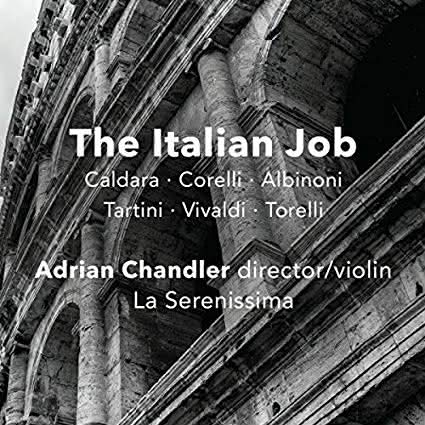
Apesar do italianíssimo nome, La Serenissima é um conjunto inglês fundado pelo virtuose Adrian Chandler. O grupo adota a prática de performances historicamente informadas, mas não temam nossos PQP-nianos amigos amantes do barroco italiano que preferem o som dos instrumentos modernos. Temos aqui o melhor dos dois mundos.
Este álbum reúne obras de compositores que vieram de quatro grandes e lindas cidades italianas.
Da sereníssima Veneza, temos Vivaldi, Albinoni e o menos conhecido Antonio Caldara, cuja deliciosa Sinfonia em dó maior abre o álbum, com o extravagante uso de trompetes, fagotes, oboés, violino solo e as outras cordas. O movimento lento, contrasta imensamente dos outros, devido a sua delicadeza e o uso de staccato.
De Roma, la Città Eterna, temos uma obra de Corelli que não é um de seus concerti grossi. A Sinfonia a Santa Beatrice d’Este é a peça mais séria do disco e foi composta para fechar um longo oratório de um outro compositor. Chandler e sua banda encontram a medida certa de energia e gravidade para apresentar propriamente a música.
Adrian Chandler
De Padova, La dotta (a sábia Pádua), temos Tartini com o seu espetacular concerto para violino. Tartini foi um precursor do compositor-intérprete-virtuose, como seriam posteriormente Paganini e Vieuxtemps, entre outros. Nesta peça Adrian Chandler tem uma ótima oportunidade de exibir seus talentos de violinista.
Seguimos de volta para Veneza, com o Padre Vermelho e seu lindo concertinho alla rustica, seguido pelo não menos mavioso concerto para fagote.
O concerto para dois oboés de Tomaso Albinoni tem um lindíssimo adagio, para derreter o mais empedernido coração.
Para fechar este ótimo disco, mais uma sinfonia com molti instrumenti, de volta muitos instrumentos de sopros e tímpanos, na generosa obra de Giuseppe Torelli, cidadão de Bologna, la grassa (a gorda), a cidade das massas e da gastronomia.
De um inspirado crítico: O álbum The Italian Job tem todas as coisas que caracterizam La Serenissima:um tom fresco, tinindo, pleno de vitalidade e divertimento, tudo parece fácil e simples para o conjunto e para os solistas, e com fundamentada erudição, tanto na escolha do programa quanto na sua execução, sem perder nem de leve qualquer graça.
The Italian Job
Antonio Caldara (c. 1671-1753)
Sinfonia para dois oboés, dois fagotes, dois trompetes, tímpanos, violino, cordas e contínuo, em dó maior
Allegro
Andante, piano e staccato
Allegro
Arcangelo Corelli (1653-1713)
Sinfonia para o Oratório a Santa Beatriced’Este, para cordas e contínuo, em ré menor
Grave
Allegro
Adagio
Largo assai
Vivace
Giuseppe Tartini (1692-1770)
Concerto para violino, cordas e contínuo, em mi maior, D 51
Allegro
Grave “Tortorella bacie…”
Allegro assai
Antonio Vivaldi (1678-1741)
Concerto ‘alla rustica’ para dois oboés, cordas e contínuo, em sol maior, RV 151
Presto
Adagio
Allegro
Concerto para fagote, cordas e contínuo, em dó maior, RV 476
Allegro
Adagio
Allegro
Tomaso Albinoni (1671-1751)
Concerto à cinque, para dois oboés, cordas e contínuo, em fá maior, Op. 9, 3
Allegro
Adagio
Allegro
Giuseppe Torelli (1658-1709)
Sinfonia para quatro trompetes, tímpanos, dois oboés, dois fagotes, dois violinos, dois violoncelos, cordas e contínuo, em dó maior, G 33
Rachel Chaplin e Gail Hennessy, oboés
Peter Whelan, fagote
La Serenissima
Adrian Chandler, violin / diretor
Gravação: 23 – 26 de agosto de 2016, St John’s, Smith Square, Londres
Resumindo, um disco para ser ouvido numa ensolarada manhã de domingo, preguiçosamente escolhendo o cardápio do almoço, deixando a louça do café da manhã para mais tarde…
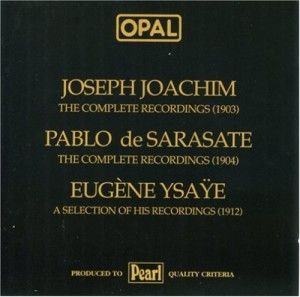
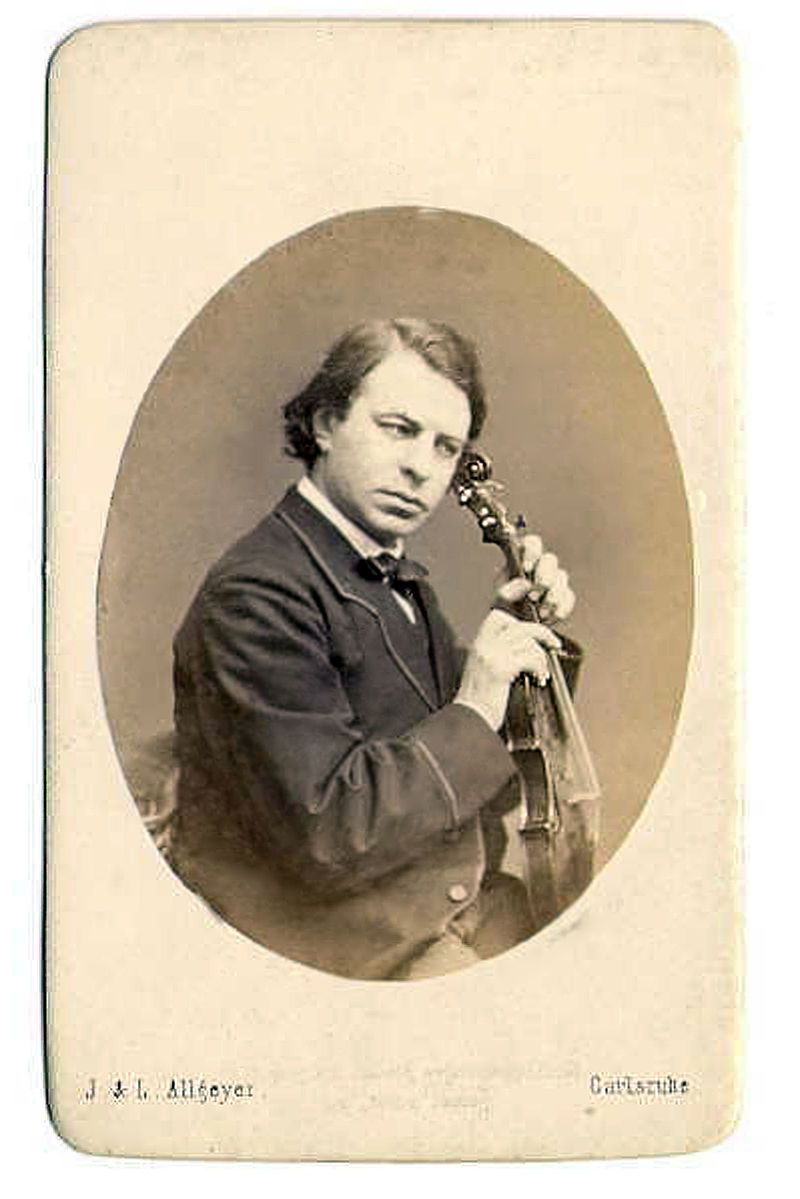
Não, você não leu errado: estas são as gravações completas dos legendários violinistas Joachim e Sarasate, feitas no começo do século XX.
Sim, Joachim: aquele que estreou sob a batuta de Felix Mendelssohn e consolidou o Concerto Op. 61 de Beethoven no repertório, que escreveu dezenas de cadenzas para concertos alheios, fundador de uma importante escola pedagógica, amigo de Schumann e de Brahms, e consultor deste último nas obras concertantes para violino.
E sim, ele mesmo: Sarasate, o mais célebre dos violinistas do século XIX depois de Paganini, receptor das dedicatórias da Sinfonia Espanhola de Lalo, do Concerto no. 2 de Wieniawski, do Concerto no. 3 e Introdução e Rondó Caprichoso de Saint-Saëns, entre outros.
De quebra, para fechar o disco, algumas das gravações que Eugène Ysaÿe, o maior violinista de seu tempo, realizou durante uma visita a Nova York em 1912.
Joseph Joachim (1831-1907)
Joachim tinha 72 anos quando realizou suas gravações – idade avançada para a época – e certamente já não estava no melhor de sua forma, tanto física quanto técnica. As técnicas primitivas de gravações, agravadas pelas dificuldades inerentes à captação do som do violino, ainda mais com as cordas de tripa que eram então a norma, exigem bastante do ouvinte que deseja apreciar a arte deste violinista legendário. As duas peças de Bach para violino solo carregam a distinção de serem as primeiras obras do Pai da Música jamais gravadas. Chamam a atenção também as ornamentações que adicionou, especialmente à bourrée, o uso muito comedido de vibrato (pois a escola fundada por Joachim assim defendia) e o que parece uma entonação distinta, que talvez estivesse em voga na distante década de 1830, quando começou a receber sua educação musical.
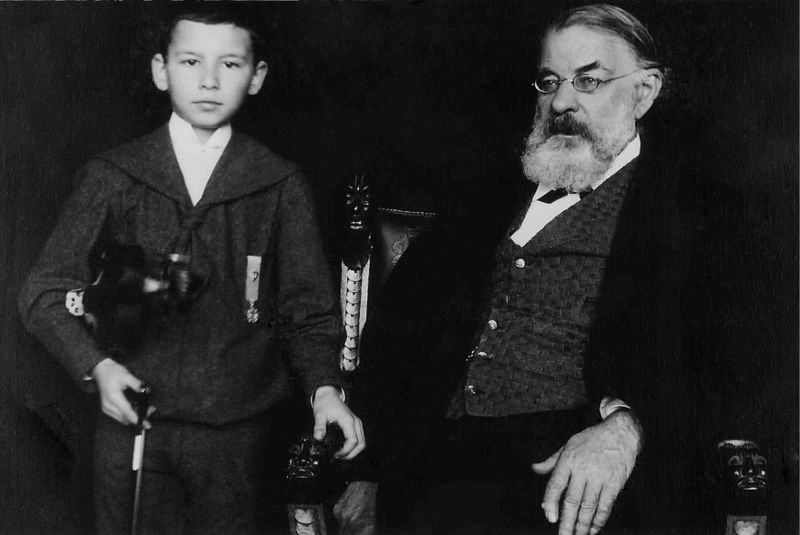
Joachim com o jovem Franz von Vecsey, em foto de 1903 – ano em que realizou suas únicas gravações. Aquele dedo indicador artrítico da mão esquerda dói só de olhar, e nos faz conceder um generoso desconto quando ouvimos os erros que ele deixou registrados para a posteridade.
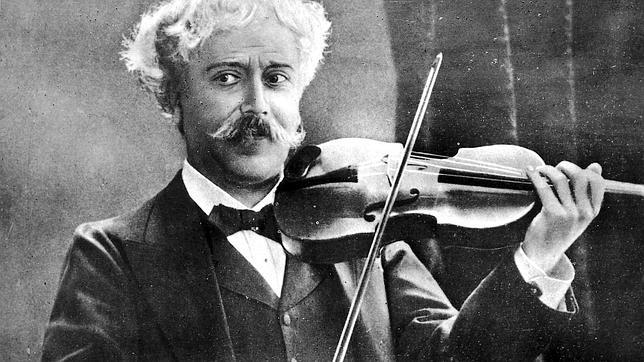
Pablo de Sarasate (1844-1908), com seu Stradivarius que pertenceu a Paganini, o mesmo instrumento usado nestas gravações.
Comedimento era o que não existia no diminuto corpo de Sarasate, virtuose de fama mundial e compositor de diversas obras feitas sob medida para exibir sua técnica. Diferentemente de Joachim, ele abusa do vibrato e, a julgar por suas gravações, apreciava andamentos insanamente rápidos. O Prelúdio da Partita em Mi maior de Bach, por exemplo, é tocada em velocidade lúbrica, mais rápido até do que era capaz o violinista sexagenário: lá pelo segundo terço ele se perde completamente, como um estudante em pânico na prova, e só vem a se recuperar quando a obra se encaminha para o final (ele parece comentar alguma coisa no fim – talvez uma exclamação desbocada – mas não a consegui entender). O arranjo do Noturno de Chopin permite apreciar um pouco de seu afamado “cantabile”, que pelo jeito abusava do portamento. No entanto, é em suas próprias obras que o basco parece se sair melhor, principalmente no “Zapateado” e nas famosas “Zigeunerweisen” (Árias Ciganas), aparentemente abreviadas para caberem na gravação – o Adagio acaba bruscamente (em meio a instruções sem-cerimoniosamente faladas pelo intérprete) para dar lugar ao velocíssimo Finale.
Eugene Ysaÿe (1858-1931)
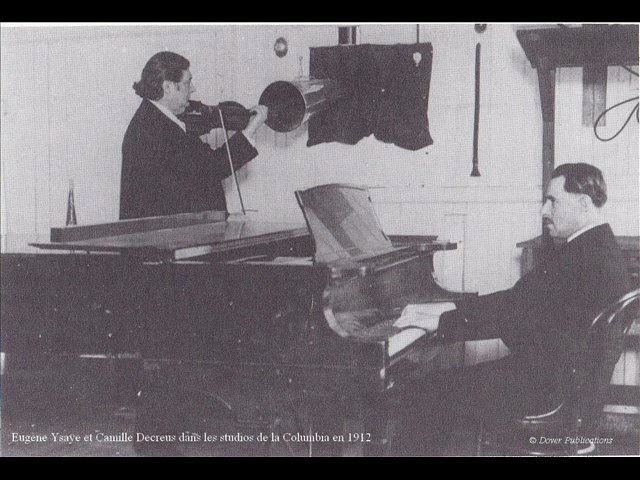
Já o belga Ysaÿe, aluno dos legendários Vieuxtemps e Wieniawski em Bruxelas, viveu até os anos 30. Por isso, deixou um legado maior de gravações, que nos soam mais modernas e muito mais satisfatórias que as de Sarasate e Joachim – mérito, também, da impressionante evolução das técnicas de gravação. O movimento final do Concerto de Mendelssohn, apesar dos cortes necessários para que coubesse num lado de um LP de 78 rpm, é bastante bom, e a famosa elegância do estilo de Ysaÿe fica evidente, apesar de algumas escorregadelas. Lembremo-nos de que as gravações eram feitas em uma só tomada, e o alto custo da mídia não permitia o luxo de repetir tomadas a bel-prazer.
Ysaÿe e o pianista Camille Decreus, realizando as gravações que vocês escutarão em breve, em Nova York (1912). Reparem no cone que fazia as vezes de microfone
Espero que apreciem estas gravações preciosas que permitem, pelo menos àqueles que lhe relevam os ruídos de superfície inerentes às limitações técnicas da época, uma fascinante viagem aural ao passado.
JOSEPH JOACHIM – THE COMPLETE RECORDINGS (1903) PABLO DE SARASATE – THE COMPLETE RECORDINGS (1904) EUGÈNE YSAYE – SELECTED RECORDINGS (1912)
Johann Sebastian BACH (1685-1750)
01 – Partita no. 1 em Si menor para violino solo, BWV 1002 – Bourrée
02 – Sonata no. 1 em Sol menor para violino solo, BWV 1001 – Adagio
Joseph Joachim, violino
(1903)
Joseph JOACHIM (1831-1907)
03 – Romance em Dó maior para violino e piano
Johannes BRAHMS (1833-1897), arranjos para violino e piano de Joseph Joachim
04 – Dança Húngara no. 1 em Sol menor
05 – Dança Húngara no. 2 em Ré menor
Joseph Joachim, violino
Pianista desconhecido
(1903)
Pablo Martín Meliton de SARASATE y Nevascués (1844-1908)
BÔNUS: vocês sabiam que não há só uma, mas DUAS gravações de Johannes Brahms ao piano? Claro que o som é precaríssimo, pois elas são de 2 de dezembro de 1889 (imaginem, menos de um mês após a Proclamação de República no Brasil!). Brahms toca uma de suas Danças Húngaras e um trecho de uma polca de Josef Strauss. Este vídeo do pianista Jack Gibbons, que tem um dos melhores canais de YouTube para amantes do piano, guia-nos nessa experiência aural a um só tempo difícil e privilegiada:
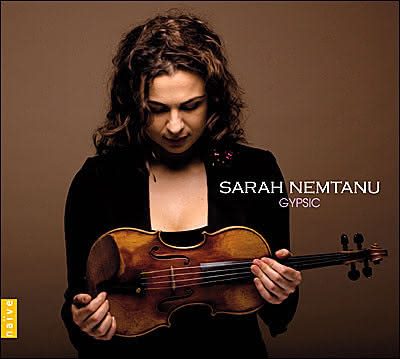
Um belo e surpreendente disco de música cigana com todo aquele ambiente exótico e sem grandes pasteurizações ou tentativas de tornar a coisa mais “elegante” (sim, entre aspas). Então, amigos puristas, por favor, fujam, evitem ouvir este Gypsic da violinista romena-francesa Sarah Nemtanu.
O restante de vocês, no entanto, deve ouvir e, talvez, ficar intrigado. O álbum não é um conjunto convencional de peças orientais e orientadas para o cigano como são tocadas há meio século. Experimente ouvir com atenção, concentrando-se especialmente nas faixas 2, 3 e 8 para que saber bem no que está se metendo. O álbum de Nemtanu também tenta adicionar elementos de transição modernos à forma tradicional do concerto cigano-clássico. Mais tradicional é a sua versão da Sonata para Violino No. 3 em Lá menor, op. 25, “On Popular Romanian Themes”, de Georges Enescu, interpretado por Nemtanu e pelo pianista Romain Descharmes de uma maneira direta que não exagera os elementos ciganos. A Tzigane de Ravel já é meio suja e ESPETACULAR. Então a diversão se acentua… O Sarasate tem uma parte adicionada. O tecladista francês nascido no Canadá, Chilly Gonzales, adiciona elementos de eletrônica às Czárdás de Vittorio Monti… Mais inacreditável ainda é o movimento Blues da Sonata de Ravel para violino e piano de 1927. Esta peça recebe de Gonzales o que Nemtanu chama de “etno-percussão” — a melodia é reformulada como um pedaço do pop etíope. É um risco, pois parece não combinar o resto da música do álbum, só com a versão das Czárdás. Talvez seja uma tentativa de criar um ponto de encontro entre a França e a Romênia. Nemtanu choca com conceitos de como a música clássica e os eletrônicos de sabor internacional podem ser juntados e seus esforços valem a pena serem ouvidos. Enfim, um disco excelente e diferente.
Maurice Ravel, Pablo Sarasate, Georges Enescu, Vittorio Monti, Georges Boulanger: Gypsic
1 Vittorio Monti – Czardas
2 Maurice Ravel – Tzigane
3 Maurice Ravel – Berceuse
4 George Enescu – Sonate premier mouvement
5 George Enescu – Sonate deuxième mouvement
6 George Enescu – Sonate troisième mouvement
7 Pablo de Sarasate – Airs Bohémiens
8 Maurice Ravel – Blues
9 Georges Boulanger – Avant de mourir
Sarah Nemtanu – Violin
Chilli Gonzales – Piano, organ farfisa, Drum, Percussion
Romain Desmarches – Piano
Iurie Morar – Cimbalom
Os capítulos dessa curta novela sobre o MESTRE Antonio Guedes Barbosa começam a minguar.
O CD da Connoisseur Society está esgotadíssimo, e o link ao lado leva a um exemplar usado pela bagatela de cento e quatro doletas. Mais ainda: ele jamais teria sido lançado no Brasil, não fosse uma ação entre clientes da Ticket Restaurante.
Sim, foi a TICKET RESTAURANTE – fiel depositária de estipêndios pagadores de coxinhas, tubaínas e churrascos gregos Brasil afora – e não a vontade das gravadoras, nem o clamor do público, a responsável pela iniciativa de distribuir esta gravação do genial pianista pessoense em seu país natal.
Se acham isso lamentável, saibam que o maravilhoso álbum triplo de Barbosa tocando as mazurcas de Chopin só chegou às praias de Pindorama graças à BOLSA DE VALORES DO RIO DE JANEIRO, que o distribuiu entre sua rapaziada como presente de final de ano.
Mas, claro, nada é tão ruim que não possa ser pior: quando encontrei este CD perdido numa loja de usados do Rio no ano passado, ele estava entre CDs do NETINHO e da BANDA BEIJO.
Três palavras mágicas que aquietam qualquer plateia quando entoadas. A elas segue um cortejo de seres mágicos, extraordinários – a Gata Borralheira, a Fada Madrinha, o Pequeno Polegar…
Os ávidos ouvintes até sabem os enredos, os desfechos dos casos, mas ainda assim esperam por eles. Neste ambiente nasce e fortalece o amor pela literatura e pelas outras artes.
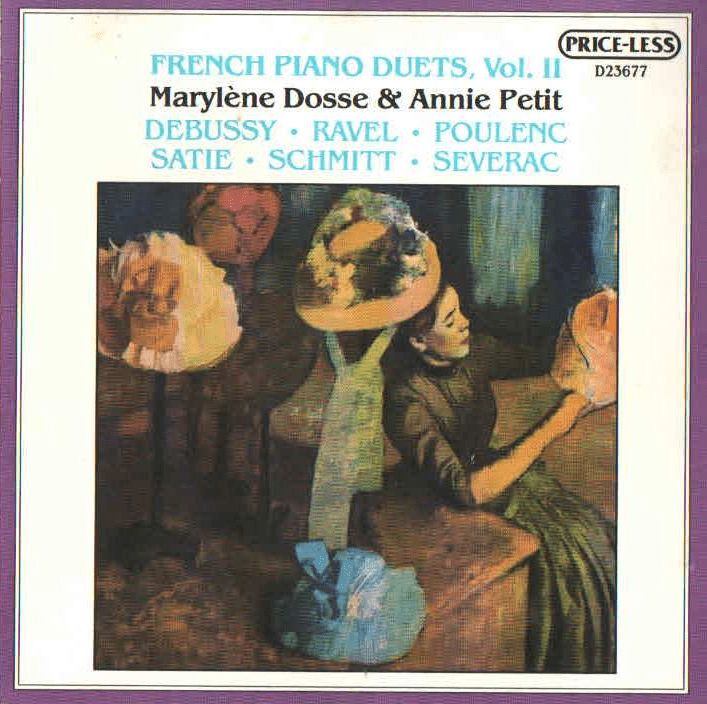
Este petit álbum reúne música com alguns temas e inspirações comuns e o universo das histórias infantis é um deles. Temos aqui obras de seis compositores franceses que as compuseram entre 1890 e 1918. São peças para piano a quatro mãos ou duetos para piano. Na virada do século XIX para o século XX esta forma musical era muito popular, pois permitia que as pessoas ouvissem boa música, mas que elas mesmas precisavam tocar. Este álbum dá uma perspectiva da música francesa para piano desta época.
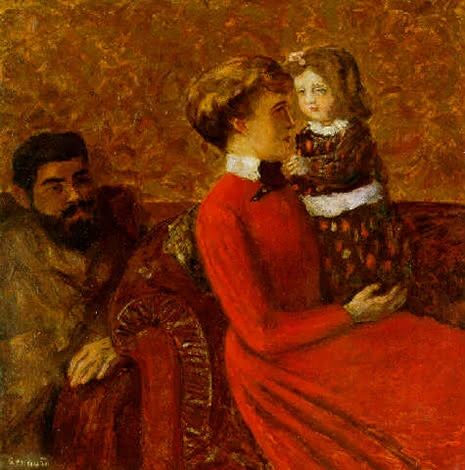
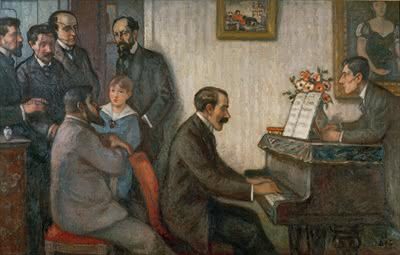
RavelA família de Cipa Godebski, por Pierre Bonnard
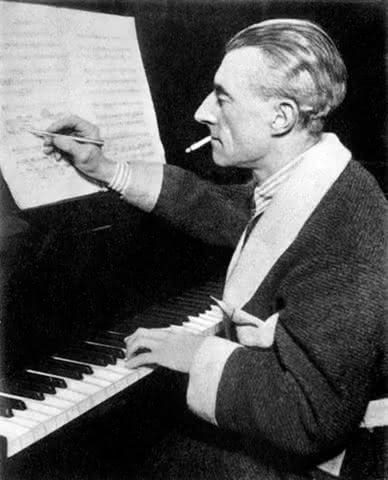
Começamos com a suíte Ma mere l’Oye, que Maurice Ravel compôs para Mimi e Jean Godebski, filhos de Ida e Cipa Godebski, grandes amigos de Ravel. Para saber quanto eles eram amigos, leia aqui.
O próprio Ravel escreveu: Era minha intenção despertar a poesia da infância nestas peças e isto naturalmente levou-me a simplificar meu estilo e diluir minha maneira de escrever.
A suíte começa com uma bela e simplíssima pavane, para uma princesa adormecida. Segue uma peça que ilustra a história do Pequeno Polegar, vagando pela floresta.
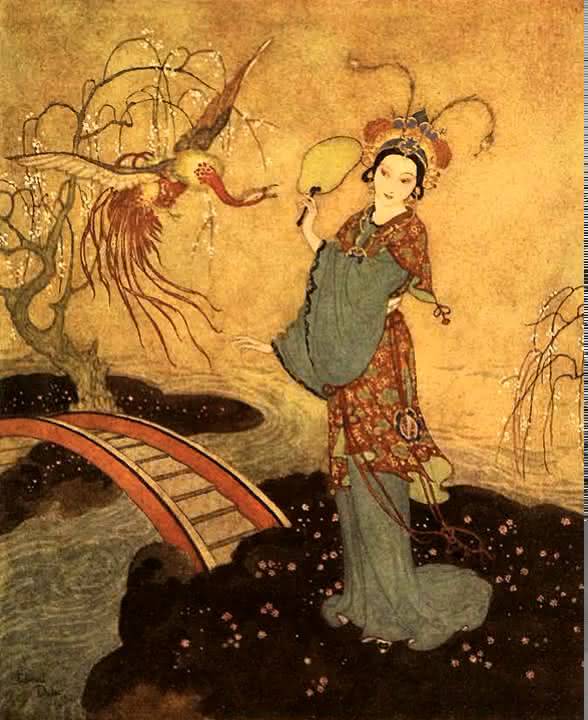
Na próxima peça, Laideronnette – Impératrice des Pagodes, encontramos um aspecto que foi caro aos compositores franceses deste período: o interesse pela música e temas orientais. Esta é uma brilhante e bem humorada elegia à Feiosanete, a Imperatiz do Pagode! Um doce para quem descobrir a história que está aqui representada…
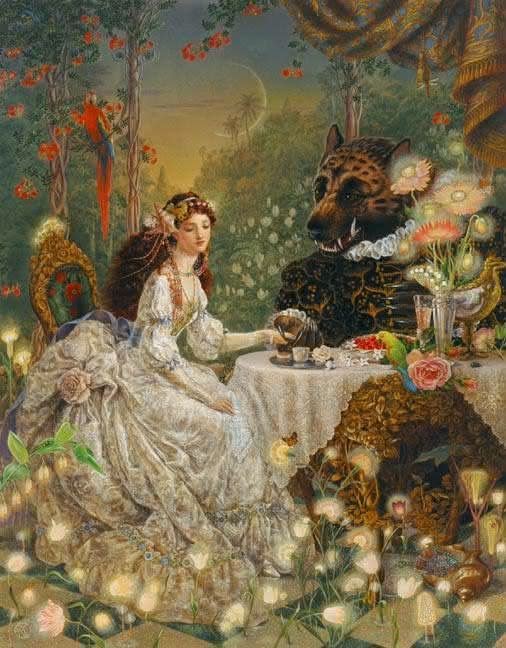
Nesta suíte de Ravel, a peça que eu mais gosto é a de A Bela e a Fera! A Fera entra em cena grunhindo (seu tema) no registro baixo e depois do beijo, um fulgurante glissando, reaparece em um registro mais alto, como o da Bela. Lindo!
Para arrematar a obra, um sensacional passeio pelo Jardim Encantado!
Debussy e seu vaso chines…
A obra de Debussy apresentada aqui chama-se Six épigraphes antiques e foi uma de suas últimas, datando de 1914. As épigraphes antiques são adaptadas da música incidental que ele escreveu para uma apresentação das Chansons de Bilitis, encenada como um recitativo em 7 de fevereiro de 1901. Apenas a metade do material foi aproveitado e o resultado é uma peça altamente atmosférica, lembrando sua origem. Os títulos, que você poderá ler por completo logo a seguir, por si são poesia pura. Pour que la nuit soit propice, pour remercier la pluie au matin.
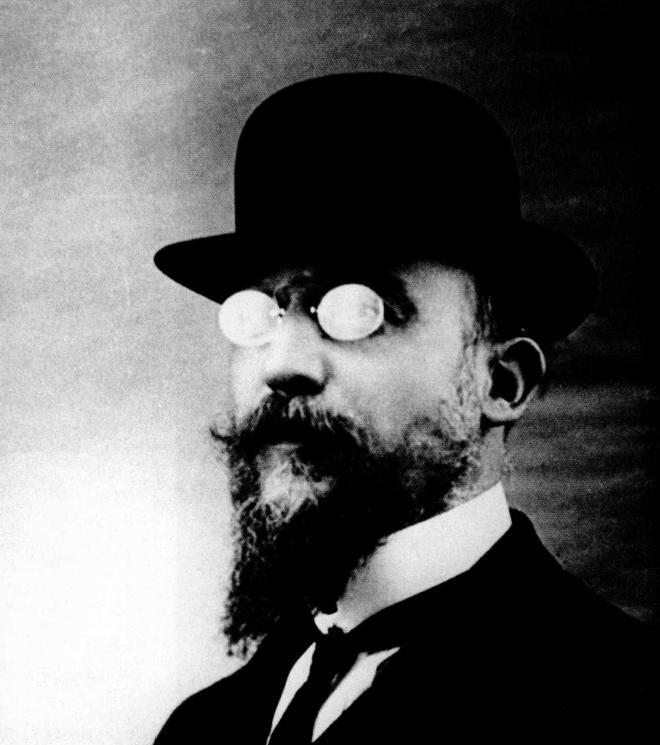
Satie
Debussy, foi amigo de Satie, mas não deixou de criticá-lo, dizendo que este deveria dar mais atenção à forma em suas composições. Pois não é que o amigo entendeu o recado e imediatamente compôs está maravilha aqui: Trois morceaux em forme de poire. Três peças em forma de pera! Erik Satie foi um músico e compositor rebelde e iconoclasta, assim como o foi em sua vida pessoal. Mesmo assim, exerceu grande influência nos outros compositores de sua geração. Seu estilo tão pessoal é baseado na simplicidade, favorecendo a sutis nuances e absoluta modéstia. No extravagante título desta peça – Trois morceaux em forme de poire, tanto responde ao comentário do amigo, quanto leva em conta o fato de poire ter duplo sentido no francês coloquial, de pera mesmo, mas também de simplório, tolo. Bem Satie!
Ele trabalhava como pianista de café em Montmartre, um caldeirão cultural na época, e a peça é baseada em música de cabaré composta entre 1890 e 1903. O famoso café Le Chat Noir, de Rudolf Salis, certamente estava entre eles. Não deixe de ouvir aqui a simples e maravilhosa valsa, Je te veux.
Séverac
A próxima peça, Le soldat de plomb, O soldadinho de chumbo, nos traz de volta ao mundo das historinhas infantis. Déodat de Séverac passou a maior parte de sua vida na província francesa de Languedoc. Sua música tem um forte traço de regionalismo. Esta peça conta bem a história e é leve e bem humorada. Ganha um Kit-Kat quem descobrir a citação da música francesa mais famosa. Composta em 1904-1905, teve sua estreia por Ricardo Viñes e Blanche Selva, em um concerto só com música de Séverac, em 25 de março de 1905, na Scola Cantorum.
A obra Le parapluie chinois, de Florent Schmitt, é a última peça de um conjunto de sete, intitulado Une semaine du petit elfe Ferme-l’Oeil. Nesta peça charmosa e brilhante temos história infantil e o apelo da música do oriente. A peça é deliciosa e uma das que mais me fez lembrar do disco. Para saber mais sobre esse ótimo compositor, veja aqui.
Florent SchmittViñes ao piano
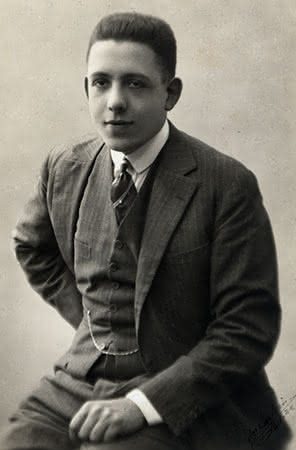
Para fechar o disco temos uma sonata em três (breves) movimentos de Poulenc, que estudou com Viñes (amigo, associado, colega e intérprete de todos os compositores deste álbum). A sonata é uma composição bem do início da carreira e foi escrita antes que Poulenc recebesse maior treinamento. Mesmo assim, a peça tem os traços que marcariam a sua obra.
Poulenc, jovemNotre-Dame du Liban, Paris
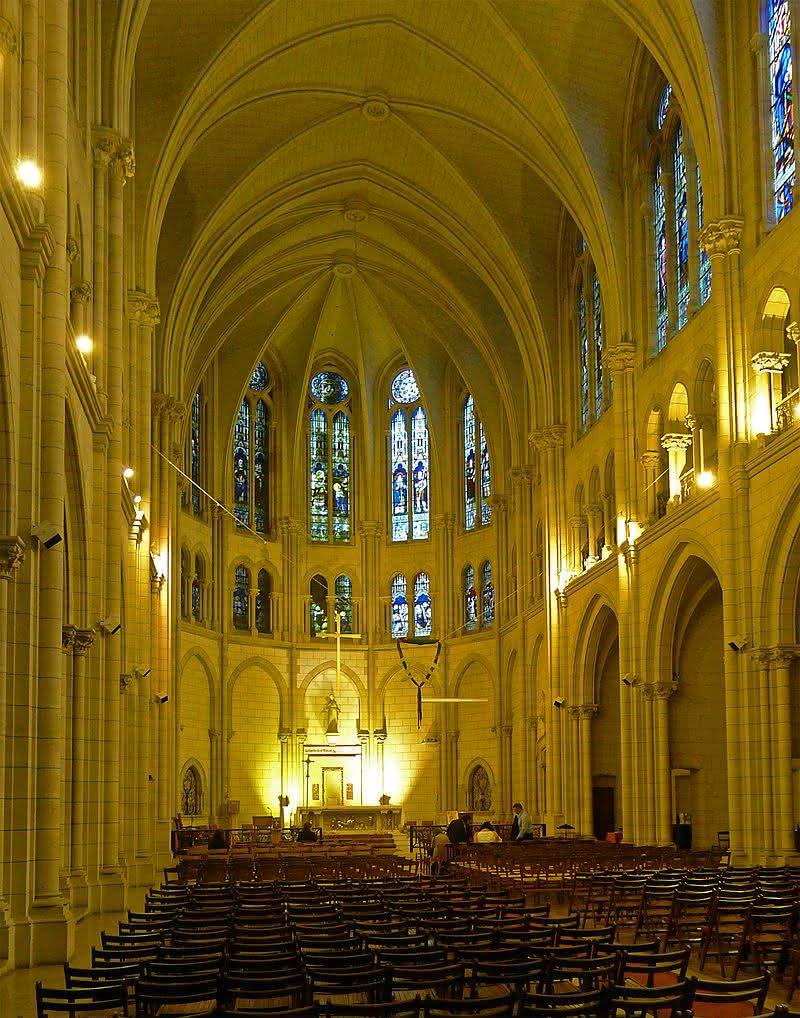
As intérpretes deste especialmente despretensioso disco, editado pelo selo americano Price-Less, Marylène Dosse e Annie Petit, estudaram no Conservatório de Paris, ganharam prêmios, mas se conheceram em Viena, em Master-Classes de Paul Badura-Skoda, Alfred Brendel e Jörg Demus. Passaram a tocar em duo quando mudaram-se para os Estados Unidos da América, onde tornaram-se professoras. As peças de Ravel, Debussy e Satie foram gravadas em 1985, na Igreja Libanesa, em Paris, onde por muitos anos foram gravados muitos e muitos discos, de artistas tais como Jean-Pierre Rampal e Maurice André. As outras peças foram gravadas em Nova Iorque, em 1988.
Maurice Ravel (1875-1937)
Ma mère l’Oye
Pavane de la Belle au bois dormant
Petit Poucet
Laideronnette – Impératrice des Pagodes
Les entretiens de la Belle et de la Bête
Le jardin féerique
Claude Debussy (1862-1918)
Six épigraphes antiques
Pour invoquer Pan
Pour um tombeau sans nom
Pour que la nuit soit propice
Pour la danseuse aux crotales
Pour l’egyptienne
Pour remercier la pluie au matin
Erik Satie (1866-1925)
Trois morceaux em forme de poire
“Avec une manière de commencement, une prolongation du même, un En Plus suivi d’une Redite”
Em uma série deste tamanho, devemos nos preparar com antecipação, não acham? Deixar tudo prontinho … quem dera, na atual conjuntura de minha vida. Mal consigo sentar no computador … com a idade vem a responsabilildade, dizem, e a falta de tempo, idem. Estou tentando manter uma periodicidade semanal, se não conseguir, só tenho a lamentar. Para os apressados, sugiro procurarem na rede mundial, está tudo lá, bonitinho.
Não pretendo me estender em maiores explicações, a obra de Bach se explica por si só. Divirtam-se.
P.S. Como sempre, Ton Kopman está muito bem de solistas nesta caixa, temos aqui a presença ilustre de Andreas Schöll …
CD 1
01. BWV.063 – 1. Chorus ‘Christen, atzet diesen Tag’
02. BWV.063 – 2. Recitative (Alto)- ‘O selger Tag! o ungemeines Heute’
03. BWV.063 – 3. Duet (Soprano, Bass)- ‘Gott, du hast es wohl gefuget’
04. BWV.063 – 4. Recitative (Tenor)- ‘So kehret sich nun heut das bange Leid’
05. BWV.063 – 5. Duet (Alto, Tenor)- ‘Ruft und fleht den Himmel an’
06. BWV.063 – 6. Recitative (Bass)- ‘Verdoppelt euch demnach’
07. BWV.063 – 7. Chorus- ‘Hochster, schau in Gnaden an’
08. BWV.162 – 1. Aria (Bass)
09. BWV.162 – 2. Recitative (Tenor)- ‘O grosses Hochzeitfest’
10. BWV.162 – 3. Aria (Soprano)- ‘Jesu, Brunquell aller Gnaden’
11. BWV.162 – 4. Recitative (Alto)- ‘Mein Jesu, lass mich nicht’
12. BWV.162 – 5. Aria (Duet- Alto, Tenor)- ‘In meinem Gott bin ich erfreut’
13. BWV.162 – 6. Chorus- ‘Ach, ich habe schon erblicket’
14. BWV.155 – 1. Recitative (Soprano)
15. BWV.155 – 2. Aria (Duet- Alto, Tenor)- ‘Du musst glauben, du musst hoffen’
16. BWV.155 – 3. Recitative (Bass)- ‘So sei, o Seele, sei zufrieden’
17. BWV.155 – 4. Aria (Soprano)- ‘Wirf, mein Herze, wirf dich noch’
18. BWV.155 – 5. Chorale- ‘Ob sichs anlie als wollt er nicht’
19. BWV.063 – Appendix 1. Duet (Soprano, Bass)
20. BWV.162 – Appendix 1. Aria (Bass)
21. BWV.162 – Appendix 2. Chorus- ‘Ach, ich habe schon erblicket’
CD 2
01. BWV.022 – 1. Arioso & Chorus (Tenor, Bass, Chorus)- Jesus nahm zu sich die Zwolfe
02. BWV.022 – 2. Aria (Alto)- Mein Jesu, ziehe mich nach dir
03. BWV.022 – 3. Recitative (Bass)- Mein Jesu, ziehe mich
04. BWV.022 – 4. Aria (Tenor)- Mein Alles in Allem
05. BWV.022 – 5. Chorus- Ertot uns durch dein Gute
06. BWV.023 – 1. Duet (Soprano, Alto)- Du wahrer Gott und Davids Sohn
07. BWV.023 – 2. Recitative (Tenor)- Ach, gehe nicht voruber
08. BWV.023 – 3. Duett & Chor (Tenor, Bass, Chorus)- Aller Augen warten, Herr
09. BWV.023 – 4. Chorus- Christe, du Lamm Gottes
10. BWV.163 – 1. Arie (Tenor)- Nur jedem das Seine
11. BWV.163 – 2. Recitative (Bass)- Du bist, mein Gott
12. BWV.163 – 3. Aria (Bass)- Lass mein Herz die Munze sein
13. BWV.163 – 4. Recitative (Soprano, Alto)- Ich wollte dir, o Gott
14. BWV.163 – 5. Aria (Soprano, Alto)- Nimm mich mir und gib mich dir
15. BWV.163 – 6. Chorus- Fuhr auch mein Herz und Sinn
16. BWV.165 – 1. Aria (Soprano)- O heilges Geist- und Wasserbad
17. BWV.165 – 2. Recitative (Bass)- Die sundige Geburt verdammter Adams Erben
18. BWV.165 – 3. Aria (Alto)- Jesu, der aus grosser Liebe
19. BWV.165 – 4. Recitative (Bass)- Ich habe, ja, mein Seelenbrautigam
20. BWV.165 – 5. Aria (Tenor)- Jesu, meines Todes Tod
21. BWV.165 – 6. Chorus- Sein Wort, sein Tauf, sein Nachtmahl
CD 3
01. BWV.054 – 1. Aria (Alto) ‘Widerstehe doch der Sunde’
02. BWV.054 – 2. Recitative (Alto) ‘Die Art verruchter Sunde’
03. BWV.054 – 3. Aria (Alto) ‘Wer Sunde tut, der ist vom Teufel’
04. BWV.161 – 1. Aria (Alto) ‘Komm, du susse Todesstunde’
05. BWV.161 – 2. Recitative (Tenor) ‘Welt, deine Lust is Last’
06. BWV.161 – 3. Aria (Tenor) ‘Mein Verlangen ist den Heiland zu umfangen’
07. BWV.161 – 4. Recitative (Alto) ‘Der Schluss ist schon gemacht’
08. BWV.161 – 5. Chorus ‘Wenn es meines Gottes Wille’
09. BWV.161 – 6. Chorus ‘Der Leib zwar in der Erden’
10. BWV.208 – 01. Recitative (Soprano) ‘Was mir behagt, ist nur die muntre Jagd’
11. BWV.208 – 02. Aria (Soprano) ‘Jagen ist die Lust der Gotter’
12. BWV.208 – 03. Recitative (Tenor) ‘Wie, schonste Gottin, wie’
13. BWV.208 – 04. Aria (Tenor) ‘Willst du dich nicht mehr ergotzen’
14. BWV.208 – 05. Recitative (Soprano, Tenor) ‘Ich liebe dich zwar noch!’
15. BWV.208 – 06. Recitative (Bass) ‘Ich, der ich sonst ein Gott in diesen Feldern bin’
16. BWV.208 – 07. Aria (Bass) ‘Ein Furst ist seines Landes Pan’
17. BWV.208 – 08. Recitative (Soprano) ‘Soll dann der Pales Opfer hier’
18. BWV.208 – 09. Aria (Soprano) ‘Schafe konnen sicher weiden’
19. BWV.208 – 10. Recitative (Soprano) ‘So stimmt mit ein’
20. BWV.208 – 11. Chorus ‘Lebe, Sonne dieser Erden’
21. BWV.208 – 12. Duet (Soprano, Tenor) ‘Entzucket uns beide’
22. BWV.208 – 13. Aria (Soprano) ‘Weil die wollenreichen Herden’
23. BWV.208 – 14. Aria (Bass) ‘Ihr Felder und Auen’
24. BWV.208 – 15. Chorus ‘Ihr lieblichsten Blicke’
BARBARA SCHLICK, CAROLINE STAM, RUTH HOLTON, ELS BONGERS soprano
ELISABETH VON MAGNUS soprano II, alto
ANDREAS SCHOLL alto(BWV54)
PAUL AGNEW tenor
KLAUS MERTENS bass
THE AMSTERDAM BAROQUE ORCHESTRA & CHOIR
TON KOOPMAN – CONDUCTOR
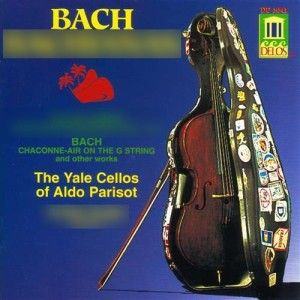
Talvez para me redimir do erro crasso que foi ignorar a gravação pioneira do decano dos violoncelistas brasileiros, o potiguar Aldo Parisot, e atribuir erroneamente a Dimos Goudaroulis a primeira gravação brasileira da integral das Suítes para violoncelo solo de J. S. Bach, apresento-lhes um belo álbum em que Parisot rege o conjunto de violoncelos da Universidade de Yale, formado por seus alunos, e que leva seu nome.
O álbum original, como vocês podem perceber pela capa rasurada, não continha somente obras de J. S. Bach, mas também outras tantas do maior dos compositores brasileiros, que se inspirou em Bach para compor um conjunto de nove obras, cujos títulos, mui apropriadamente, remetem a Bach. Duas dessas obras – a primeira e quinta da série – foram compostas para conjunto de violoncelos (acompanhados, na quinta, por uma soprano solista, que nesta gravação é a excelente Arleen Augér).
Lamentavelmente, não temos a autorização dos representantes dos direitos de tal compositor para divulgar suas obras por aqui. Assim, deixamos que as obras de Bach lhes mostrem a beleza do som do coro de violoncelos burilado por Parisot, enquanto vocês ficam imaginando como as obras do compositor-de-quem-não-se-diz-o-nome não soariam com esse conjunto.
Ou, ah sim, também podem comprar o disco. É só clicar a imagem acima.
(ou, então, escutar no YouTube – mas, shhhhhh, não espalhem!)
JOHANN SEBASTIAN BACH (1685-1750)
01 – Suíte para orquestra no. 3 em Ré maior, BWV 1068 – Ária
02 – Partita para violino solo no. 2 em Ré menor, BWV 1004 – Chaconne
03 – O Cravo bem Temperado, livro I – Prelúdio e Fuga em Mi bemol menor, BWV 853
04 – O Cravo bem Temperado, livro I – Prelúdio em Si bemol menor, BWV 867
05 – Suíte para violoncelo solo no. 6 em Ré maior, BWV 1012 – Sarabande
The Yale Cellos of Aldo Parisot Aldo Parisot, regência
Arranjos para conjunto de violoncelos: Aldo Parisot
(os excertos d’O Cravo bem Temperado foram arranjados, parece, por um grande compositor brasileiro)
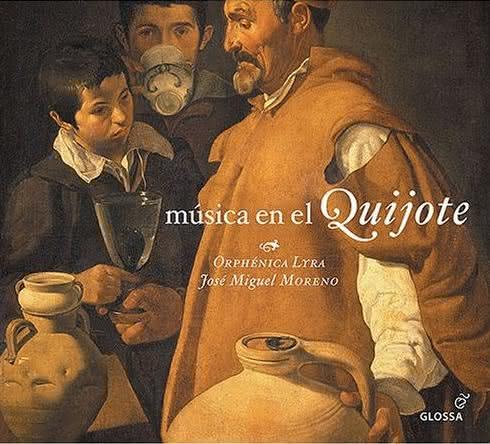
Quando ouvi este CD ela primeira vez, o Quixote completava 400 anos. Eu estava perante uma contribuição distinta para a celebração do 4º centenário da obra-prima de Cervantes. Eu ouvia um trabalho que não era a “música nos tempos do…”, nem uma associação de um compositor ao mito com base unicamente na sua coincidência no tempo, nem uma obra inspirada no romance, mas precisamente aquela que todos sentiam falta: uma espécie de “trilha sonora” do Quixote, as próprias referências citadas pelo livro. Ou seja, aquilo que apimenta o grande trabalho de Cervantes e algumas de suas Novelas Exemplares são coletadas e executadas com amor e respeito. Romances e canções alternam-se com danças como chaconnes, folías e jácaras, criando uma paisagem musical bonita e precisa, na qual o bom leitor localizará facilmente as aventuras do nosso herói.
O disco marcava também o reencontro de José Miguel Moreno com seu renovado grupo, o Orphénica Lyra, após alguns anos. Nuria Rial, com uma voz que nos eleva a alturas sublimes de beleza, sensibilidade e agilidade, compartilha a cena com uma surpreendente Raquel Andueza, e ambos os sopranos se juntam à voz de Jordi Domenech. Um absurdo de perfeição. No âmbito instrumental, temos um conjunto que sabe transmitir o sabor da era cervantina: Eligio Quinteiro, Fernando Paz, Fahmi Alqhai e Álvaro Garrido, conduzido da vihuela por um Moreno em pleno comando de seus poderes.
Música en el Quijote: Romances, songs, instrumental pieces
01 Luys Milán: Pavana VI
02 Anónimo: Al alva venid
03 Juan Arañés: Chacona
04 Luys Milán: Romance de Durandarte
05 Alonso Mudarra: Gallarda
06 Francisco Guerrero: Prado verde y florido
07 Anónimo: Qué me queréis, caballero
08 Anónimo: Romance de Don Gayferos
09 Antonio Martín Y Coll: Canarios
10 Anónimo: Madre, la mi madre
11 Anónimo: Ay luna que reluces
12 Anónimo: Jácaras
13 Alonso Mudarra: Fantasía X, sobre la folía
14 Luys Milán: Romance de Valdovinos
15 Antonio Martín Y Coll: Villanos
16 Anónimo: Qué bonito niño chiquito
17 Alonso Mudarra: Beatus ille
18 Antonio de Ribera: Romance de Cardenio
19 Diego Coll: Recercada segunda
20 Gabriel: De la dulce mi enemiga
21 Anónimo: Romance del Marqués de Mantua
22 Diego Pisador: Flérida, para mí dulce
23 Anónimo: Al villano se la dan
24 Luys de Narváez: Romance de Conde Claros
25 Diego Ortiz: Recercada octava
26 Juan Arañés: Chacona: A la vida bona
Intérpretes: Orphénica Lyra : Nuria Rial, soprano; Raquel Andueza, soprano; Jordi Domenech, countertenor; Eligio Quinteiro, Renaissance guitar; Fernando Paz, recorders; Fahmi Alqhai, viola da gamba; Álvaro Garrido, percussion; José Miguel Moreno, vihuela y dir.
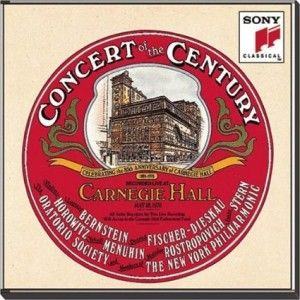
“Concerto do Século” é um título bastante presunçoso para esta gravação da celebração dos 85 anos (jubileu esquisito, né?) do Carnegie Hall em Nova York, e que eu comprei no Carrefour nos anos 90.
Os talentos reunidos talvez justifiquem a presunção: afinal, se hoje Leonard Bernstein, Isaac Stern, Yehudi Menuhin, Vladimir Horowitz, Slava Rostropovich e Dietrich Fischer-Dieskau provavelmente estão, entre uma piada e outra de Slava, a fazer música no Olimpo, no tempo em que eles repartiam conosco o ar pestilento do Hades era bem difícil vê-los repartindo um palco.
O repertório é um saco de gatos difícil de entender, cujo único critério de eleição, parece, era o da Roda da Fortuna. Talvez quisessem apenas achar pretextos para reunir o notável panteão musical e ganhar dinheiro com isso – a edição de luxo da gravação, por exemplo, limitada a mil exemplares e autografada pelos artistas, ainda pode trocar de mãos pela ninharia de duas mil e trezentas doletas.
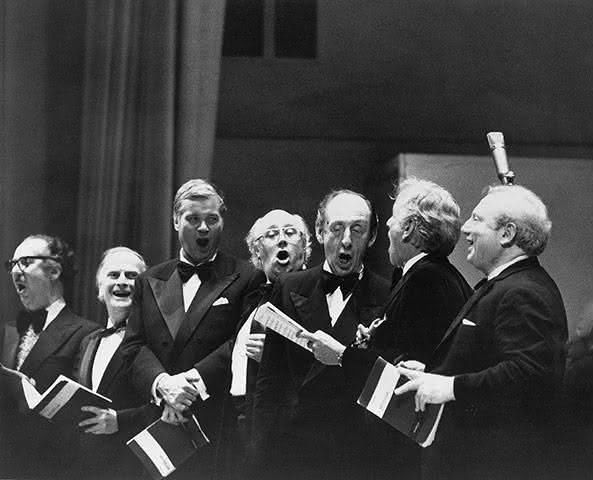
Essa, no entanto, é uma questão que empalidece quando imaginamos o espetáculo sui generis que não deve ter sido assistir aos célebres instrumentistas cantando (!) o Hallelujah de Händel que encerra o festim musical. Não conseguimos, em momento algum, discernir suas vozes em meio ao coro e, por isso, provavelmente devamos à Oratorio Society e à Filarmônica de New York nossos efusivos agradecimentos.
Ver Horowitz soltando um dó de peito certamente foi uma das trombetas do Apocalipse, mas o fechamento meio bizarro do concerto não condiz com algumas das belezas nele contidas. Ok, o Concerto Duplo de Bach com Stern e Menuhin é decepcionante, meio cru e cheio de arestas, e também fica difícil entender por que o “Pater Noster” à capela de Tchaikovsky está ali, perdido entre Bach e Händel. No entanto, o “Pezzo Elegiaco” que abre o belo Trio em Lá menor de Tchaikovsky (com Stern, Horowitz e Rostropovich) e o Andante da Sonata para violoncelo e piano de Rachmaninov (com Rostropovich e Horowitz) são tão bons que a gente fica cá com os botões a se perguntar por que diachos deles foram tocados só excertos.
O ouro maciço, entretanto, está no MA-RA-VI-LHO-SO “Dichterliebe” de Schumann, na voz de seu maior intérprete, Dietrich Fischer-Dieskau, e com Horowitz ao piano. Não conseguiríamos tecer loas bastantes à maior voz do século XX, então concentramos nossos confetes sobre Horowitz, que não só acompanha impecavelmente como também acrescenta tensão e lirismo a momentos cruciais. Para mim, esta é disparadamente a melhor gravação que existe desta obra-prima do gênero, e tenho certeza de que, se fosse lançada separadamente e não escondida neste saco de gatos de pedigree, seria um sempiterno sucesso.
CONCERT OF THE CENTURY – CELEBRATING THE 85th ANNIVERSARY OF CARNEGIE HALL
Gravado ao vivo em 18 de maio de 1976
Ludwig van BEETHOVEN (1770-1827)
01 – Abertura “Leonore”, Op. 72a
New York Philarmonic Leonard Bernstein, regência
Pyotr Ilyich TCHAIKOVSKY (1840-1893)
02 – Trio em Lá menor para violino, piano e violoncelo, Op. 50 – Pezzo elegiaco
Isaac Stern, violino Vladimir Horowitz, piano Mstislav Rostropovich, violoncelo
Sergey Vasilyevich RACHMANINOV (1873-1943)
03 – Sonata em Sol menor para violoncelo e piano, Op. 19 – Andante
Mstislav Rostropovich, violoncelo Vladimir Horowitz, piano
Isaac Stern, Yehudi Menuhin, Vladimir Horowitz, Mstislav Rostropovich, Leonard Bernstein, Dietrich Fischer-Dieskau, vozes The Oratorio Society New York Philarmonic Leonard Bernstein, regência
 No quarto CD da série, volta-se para onde se começa: lá do começo.



![Paul is not dead: celebrando a vida de Paul Badura-Skoda (A Man and His Music – Young and Curious [1941-46])](https://pqpbach.ars.blog.br/wp-content/uploads/2019/09/Badura-CD1-Inner-960x880.jpg)
 Há dois dias, algumas postagens em minhas redes sociais deram conta do desaparecimento, aos 91 anos, do grande Paul Badura-Skoda, o subdecano dos pianistas (pois o decano é, sem dúvidas, o incansável