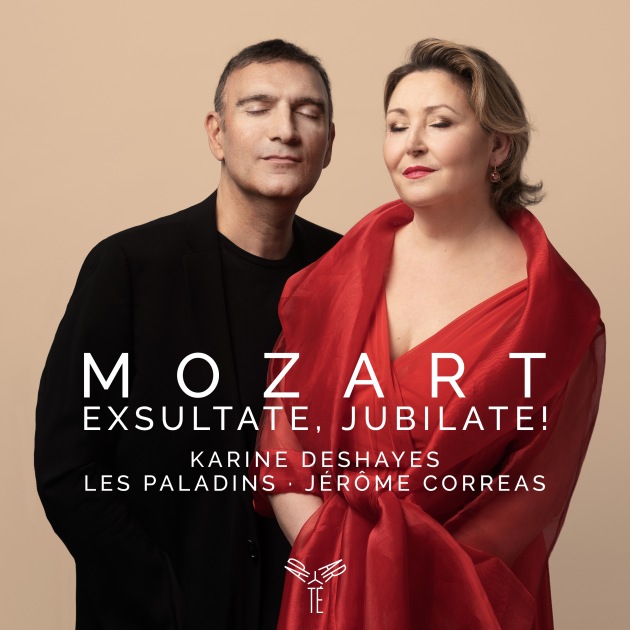
 Uma capa meio estranha: parece que a cantora e o maestro estão sentindo um cheiro forte, se seria um fedor (será que havia no estúdio um francês que estava há 3 dias sem banho?) ou um aroma sublime de flores da primavera, deixo a escolha para nossos leitores. Mas se os dois talvez não sejam tão convincentes na capa (ou seria culpa do fotógrafo?), no álbum a visão de Mozart que eles apresentam é bastante convincente. Com um repertório centrado na primeira metade da carreira do precoce compositor, eles misturam música sacra e profana, mostrando a originalidade e beleza das obras.
No libreto do álbum, uma entrevista do maestro traz o seu ponto de vista sobre as obras da primeira metade da carreira de Mozart: interessa para ele mostrar como certos aspectos da visão de mundo barroca estão presentes ali.
I mentioned earlier the theatricality of Baroque and Classical music: every one of my projects concerns this. In my opinion, it’s enough to look at a painting from these periods to see the extreme theatricality of the representations, to which music is obviously no exception, whether secular or sacred. With this programme, I wanted to mix sacred and secular works in a dramatic perspective. It seems to me that this was how music was conceived during Mozart’s lifetime, as testimonies always mention extremely moving singers with persuasive power and highly expressive, contrasting voices… even in church music! Contrary to the 19th century’s ethereal image of the genre, 18th-century treatises indicate that voices must be large and highly expressive in order to convey the message of the text in vast spaces dedicated to worship. There is therefore a porous boundary between the vocal idiom of the sacred and secular repertoires which is doubtless a matter for further reflection. The motet Exsultate, jubilate, around which this programme was built, illustrates this very well: Mozart composed it for the castrato Venanzio Rauzzini, having been won over by his performance of his opera Lucio Silla. The two works don’t have the same subject matter at all, which shows that it was Rauzzini’s intrinsic qualities that prompted Mozart to approach an operatic and a sacred piece in the same spirit.
How do the other works presented here relate to Exsultate?
I wanted to create a journey centred on Mozart in the dying years of the Baroque, at the crossroads with Classicism, so I chose works from the decade 1770-80. When he composed the Exsultate, he was 17 years old and still very much imbued with the virtuosic Neapolitan writing inherited from the previous generation, that of Hasse, Jommeli or Traetta. The arias of La Betulia Liberata or Davide Penitente (itself derived from the Great Mass in C minor), or his 17th symphony, whose opening pages are reminiscent of an opera seria aria, testify to this. Mozart did not feel free in Salzburg: he was at the mercy of his employer, Archbishop Colloredo, and imprisoned within a certain tradition… which he worked to crack open, as demonstrated by his Church Sonatas – veritable miniature symphonies whose thematic material he would later reuse.
Rather than thinking of Mozart as having a ‘Mozartian’ style, I prefer to think of him as someone who was constantly searching and questioning himself in order to progress. Mozart must have been very afraid of getting bored – you can sense this in the perpetual forward motion of his works. And in this quest for freedom, youth and ardour that strikes our ears, he achieves suspended moments of poetry and transcendence: the Agnus Dei from the Coronation Mass, the Laudate Dominum from the Vesperæ solennes de confessore, which reminds me of bel canto and Bellini’s “Casta Diva”, with its long, highly refined line in the form of an arch above the regular motion of the orchestra…
W.A. Mozart (1756-1792):
1. La Betulia Liberata, K. 118/74c: Aria: Quel nocchier che in gran procella (Amital) 06:09
2. Sinfonia nº 17 em Sol Maior, K. 129: I. Allegro 04:17
3. Sinfonia nº 17 em Sol Maior, K. 129: II. Andante 04:01
4. Sinfonia nº 17 em Sol Maior, K. 129: III. Allegro 03:55
5. Davide Penitente, K. 469: Aria: Lungi le cure ingrate 04:48
6. Church Sonata in D Major, K. 69 02:36
7. Church Sonata in G Major, K. 274 03:34
8. Church Sonata in D Major, K. 144 03:16
9. Mass in C Major, K. 317 ‘Coronation’: Agnus Dei 03:11
10. Church Sonata in E-Flat Major, K. 67 02:39
11.Exsultate, jubilate, K. 165: I. Exsultate, jubilate 04:43
12.Exsultate, jubilate, K. 165: II. Fulget amica dies 00:50
13.Exsultate, jubilate, K. 165: III. Tu virginum corona 05:38
14.Exsultate, jubilate, K. 165: IV. Alleluia, alleluia 02:35
15.Vesperæ solennes de confessore, K. 339: V. Laudate Dominum 02:42
Karine Deshayes, soprano
Les Paladins, Jérôme Correas
Pleyel